
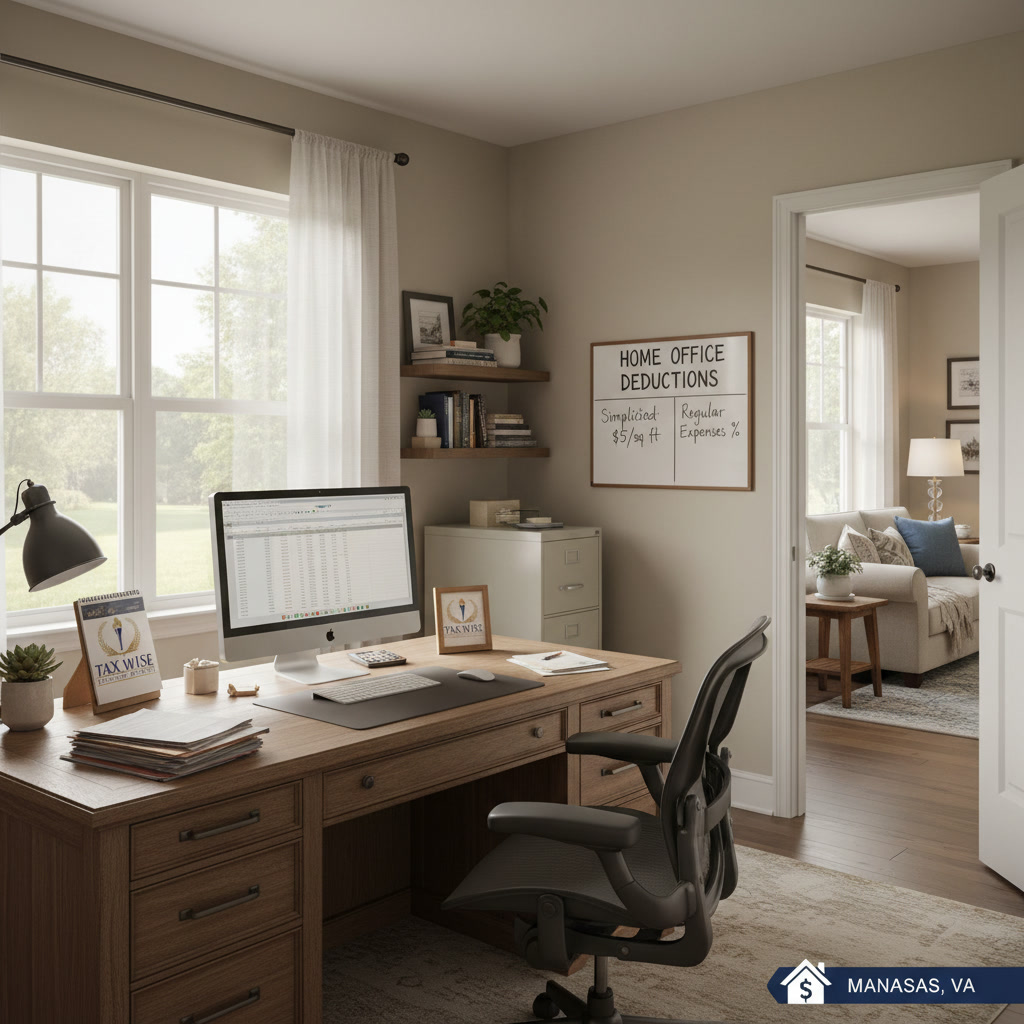
Working from home has become a practical solution for entrepreneurs, freelancers, consultants, and small business owners across Manassas, Virginia. Whether you operate a business from a dedicated room or manage clients from a home workspace, understanding home office deductions can help you reduce eligible business expenses and potentially lower your federal income tax liability.
However, not every home workspace qualifies for a tax deduction. The Internal Revenue Service (IRS) has specific requirements regarding how a home office must be used, which expenses qualify, and how deductions should be calculated.
For individuals seeking Tax savings Manassas, understanding these rules is an important part of effective financial planning. By identifying qualifying expenses and maintaining accurate records, eligible business owners can take advantage of deductions while remaining compliant with federal tax regulations.
This guide explains the home office deduction rules for the 2025 tax year, including eligibility requirements, deductible expenses, calculation methods, and practical strategies for Manassas residents.
Understanding Home Office Tax Deductions
A home office deduction allows qualifying self-employed individuals and business owners to deduct certain expenses associated with using part of their residence for business activities.
These deductions recognize that operating a business from home often involves additional costs, including electricity, internet services, maintenance, and the use of living space for professional purposes.
For example, a freelance graphic designer in Manassas who uses a dedicated bedroom exclusively for business may qualify to deduct certain home-related expenses.
The amount depends on factors such as the workspace’s size, eligible expenses, business income, and the calculation method selected.
Who Can Claim a Home Office Deduction?
For the 2025 federal tax year, the deduction is generally available to qualifying self-employed taxpayers, including:
- Freelancers and independent contractors.
- Sole proprietors operating businesses from home.
- Self-employed consultants and professional service providers.
- Small business owners who regularly use a qualifying home workspace.
- Certain partners and other taxpayers whose circumstances satisfy applicable tax rules.
Employees who receive a W-2 generally cannot deduct home office expenses on their personal federal income tax returns, even if their employers require them to work remotely.
This distinction is especially important for Manassas residents who work remotely for companies based in Washington, D.C., Northern Virginia, or elsewhere in the United States.
Working from home does not automatically make someone eligible for the deduction. The nature of the taxpayer’s work and the use of the workspace determine eligibility.
When Does Your Home Office Qualify for a Tax Deduction?
The IRS generally requires taxpayers to satisfy specific standards before claiming home office expenses.
1. Exclusive Business Use
The workspace must generally be used exclusively for business purposes.
For example, a dedicated room containing a desk, computer, filing cabinet, and business equipment may qualify if it is not also used for personal activities.
However, a dining table used for business during the day and family meals in the evening generally does not meet the exclusive-use requirement.
A home office does not necessarily need to be an entire room. A clearly identifiable portion of a room may qualify if it is used exclusively and regularly for business.
2. Regular Business Use
The workspace must also be used consistently for business activities.
Occasional or incidental business use generally does not satisfy the IRS requirements.
For instance, a Manassas-based accountant who uses a dedicated home office throughout the week for bookkeeping and client communications may meet the regular-use requirement.
By contrast, someone who occasionally answers business emails from a guest bedroom may not qualify.
3. Principal Place of Business
In many situations, the home office must serve as the taxpayer’s principal place of business.
This does not necessarily mean that all business activities must occur at home.
A self-employed contractor, for example, may perform services at customer locations while using a qualifying home office for invoicing, scheduling, bookkeeping, and other administrative responsibilities.
A home office may qualify as the principal place of business when it is used exclusively and regularly for administrative or management activities and the taxpayer has no other fixed location where substantial administrative or management activities are conducted.
Certain qualifying spaces used to meet clients or customers, and separate structures used for business, may also satisfy the applicable rules.
Exceptions to Exclusive Use
The IRS recognizes limited exceptions for certain business activities, including:
- Qualifying storage of inventory or product samples.
- Certain daycare businesses operated from a residence.
These situations have additional requirements, and the deduction may be calculated differently.
Understanding these eligibility standards is essential before claiming a home office deduction.
What Home Office Expenses Are Tax-Deductible?
One of the biggest advantages of qualifying for a home office deduction is the ability to allocate certain household expenses to business use.
However, not all household costs are deductible, and the applicable rules depend on the method used to calculate the deduction.
Direct Home Office Expenses
Direct expenses are costs that benefit only the business portion of the home.
Examples may include:
- Painting a dedicated home office.
- Repairing a damaged wall inside the workspace.
- Installing or repairing lighting specifically for the office.
- Making eligible repairs that affect only the business area.
Under the actual-expense method, qualifying direct expenses are generally allocated entirely to the business workspace, subject to applicable limitations.
Indirect Home Office Expenses
Indirect expenses benefit the entire residence rather than only the office.
Eligible taxpayers may be able to deduct the business-use portion of expenses such as:
- Rent.
- Mortgage interest.
- Real estate taxes.
- Electricity and heating.
- Water and other qualifying utilities.
- Homeowners or renters insurance.
- General home repairs and maintenance.
- Certain home security costs.
- Depreciation of the qualifying business portion of an owned home.
The deductible portion is generally determined by the percentage of the home used for business.
For example, if a qualifying office occupies 10% of a residence, approximately 10% of eligible indirect household expenses may be allocated to business use under the actual-expense method.
Special rules apply to expenses such as mortgage interest, property taxes, and depreciation.
Internet, Phone, and Office Equipment
Business-related internet and telephone expenses may also be deductible under applicable business-expense rules.
For example, if an independent consultant uses 60% of a household internet connection for business, the documented business portion may qualify as a business expense.
Similarly, qualifying expenses for computers, printers, office furniture, software, and supplies may be deductible separately from the home office deduction.
These items have their own tax treatment and should not automatically be included in the home office expense calculation.
The basic charge for the first residential telephone line generally is not deductible simply because the phone is also used for business.
Two Methods for Calculating Home Office Deductions
Eligible taxpayers can generally choose between the simplified method and the actual-expense method.
Each approach has advantages depending on the size of the workspace, household expenses, and recordkeeping preferences.
Simplified Method
The simplified method allows qualifying taxpayers to calculate their deduction using a standard rate of $5 per square foot of eligible home office space.
The maximum allowable area is 300 square feet, resulting in a maximum deduction of $1,500 for a full year of qualifying use, subject to income limitations.
Example: Simplified Home Office Deduction
Qualifying office area
180 sq. ft.
Estimated annual deduction for full-year qualifying use
$900
Calculated at $5 per square foot, capped at 300 square feet. Assumes sufficient qualifying business income and does not represent a tax refund.
The simplified method reduces the need to calculate and allocate actual home operating expenses.
However, taxpayers must still meet the eligibility requirements and maintain sufficient documentation of their business use.
Actual-Expense Method
The actual-expense method calculates deductions using eligible household costs and the percentage of the home devoted to qualifying business activities.
Consider a hypothetical Manassas homeowner with the following information:
| Expense category | Annual amount |
|---|---|
| Utilities | $3,600 |
| Homeowners insurance | $1,800 |
| General home maintenance | $1,200 |
| Mortgage interest | $8,000 |
| Property taxes | $4,000 |
| Total eligible example costs | $18,600 |
Assume the qualifying home office occupies 12% of the total residence.
The preliminary allocated expense amount would be:
$18,600 × 12% = $2,232
This example illustrates the allocation calculation, not a guaranteed deduction. The actual allowable amount depends on the taxpayer’s circumstances, income limitations, mortgage-interest and tax rules, and any other applicable adjustments. Depreciation and qualifying direct expenses may also affect the result.
Which Method Is Better?
| Simplified method | Actual-expense method |
|---|---|
| Easier calculation | More detailed calculation |
| $5 per eligible square foot | Based on qualifying actual costs |
| Maximum $1,500 before income limits | No fixed $1,500 cap |
| No home depreciation deduction | May include allowable depreciation |
| Less recordkeeping | Requires detailed expense records |
Taxpayers may choose the method that works best for a particular tax year, but once the method is elected on a timely filed original return, the choice generally cannot be changed for that year.
The IRS provides additional guidance on its simplified home office deduction page.
How Manassas Business Owners Can Maximize Home Office Tax Savings
Effective tax planning involves more than simply identifying deductible expenses.
Business owners should understand how to organize their records, measure business use, and avoid common reporting mistakes.
Keep Accurate Financial Records
Maintaining organized records helps substantiate deductions and simplifies tax preparation.
Useful documents include:
- Monthly utility bills.
- Mortgage interest statements or rent records.
- Property tax statements.
- Insurance invoices.
- Receipts for office repairs and improvements.
- Business-related internet and telephone records.
- Floor plans or measurements showing the qualifying workspace.
Digital bookkeeping systems can help self-employed individuals track these expenses throughout the year.
Measure Your Workspace Correctly
Accurate measurements are important when determining the business-use percentage.
For example, if a qualifying workspace measures 200 square feet within a 2,000-square-foot home, the business-use percentage would generally be 10%.
Homeowners should avoid including personal living areas, shared family spaces, or other nonqualifying areas in their calculations.
Separate Personal and Business Expenses
Maintaining separate business and personal financial records can make tax preparation significantly easier.
A dedicated business bank account and organized expense categories can help establish which payments relate to business operations.
This practice is especially useful for independent contractors, consultants, and home-based business owners managing multiple income sources.
Review Deductions Annually
Business expenses and workspace arrangements can change from year to year.
A homeowner may relocate to a larger office, begin using additional space for personal activities, or experience significant changes in utility costs.
Reviewing the deduction annually helps ensure the calculation reflects the taxpayer’s actual circumstances.
For individuals exploring Tax savings Manassas, consistent recordkeeping and annual tax planning can help identify legitimate opportunities to reduce taxable business income.
Common Home Office Deduction Mistakes to Avoid
Although home office deductions can provide valuable tax benefits, incorrect claims may result in disallowed expenses, additional taxes, or penalties.
Claiming a Multipurpose Workspace
Using a room for both personal and business activities generally violates the exclusive-use requirement.
A guest bedroom that doubles as an office, for example, may not qualify if the same area is regularly used for personal purposes.
Deducting All Household Expenses
The home office deduction does not ordinarily allow taxpayers to deduct the entire cost of rent, electricity, insurance, or mortgage interest as business expenses.
Only the eligible business-use portion of applicable indirect expenses may generally be deducted under the actual-expense method.
Claiming Expenses Without Documentation
Taxpayers should retain sufficient evidence to support their claimed deductions.
Estimates without reliable supporting records can create problems if the IRS requests additional information.
Overlooking Deduction Limitations
Home office deductions are subject to business-income limitations.
For example, a taxpayer generally cannot use home office expenses to create or increase a business loss through the deduction.
Under the actual-expense method, certain disallowed amounts may be carried forward to future tax years. The simplified method does not provide the same carryover treatment.
Ignoring Depreciation Consequences
Homeowners using the actual-expense method may need to account for depreciation associated with the business portion of their residence.
Depreciation can have consequences when the home is eventually sold, including potential taxable gain attributable to depreciation.
A qualified tax professional can help evaluate these considerations before selecting a deduction method.
Home Office Deductions and Virginia State Taxes
Manassas residents should also consider how federal business deductions interact with Virginia income taxes.
Virginia generally begins its individual income tax calculation with federal adjusted gross income, subject to state-specific additions, subtractions, and other adjustments.
As a result, eligible federal business deductions may also affect Virginia taxable income.
However, Virginia does not necessarily treat every federal tax provision identically, and the applicable rules should be reviewed for the relevant tax year.
Additionally, Manassas business owners should distinguish federal home office deductions from local business licensing and tax requirements.
Depending on the nature and location of the business, local licensing or zoning requirements may apply independently of whether a taxpayer qualifies for a federal home office deduction.
Consulting a professional familiar with both federal and Virginia tax regulations can help business owners address these obligations appropriately.
How to Claim the Home Office Deduction for 2025
Eligible sole proprietors generally report the home office deduction on Schedule C, which accompanies their federal individual income tax return.
The process depends on the calculation method selected.
Using the Simplified Method
Taxpayers generally calculate the deduction using the simplified method worksheet and report the allowable amount on Schedule C, Line 30.
Using the Actual-Expense Method
Eligible sole proprietors generally complete IRS Form 8829, Expenses for Business Use of Your Home, to calculate the deduction.
The resulting allowable deduction is then transferred to Schedule C.
Other taxpayers, including certain partners and farmers, may have different reporting procedures.
The IRS instructions for Form 8829 explain eligibility, expense allocation, limitations, and reporting requirements for the 2025 tax year.
Frequently Asked Questions About Home Office Deductions
Can I deduct my home office if I rent a house in Manassas?
Yes. Eligible self-employed renters may qualify for home office deductions if they satisfy the applicable IRS requirements.
Under the actual-expense method, the business-use portion of rent and other eligible household expenses may be deductible.
Can I claim a deduction if I work remotely for an employer?
Generally, no. W-2 employees cannot claim the federal home office deduction for 2025 simply because they work from home.
However, individuals who also operate a separate qualifying self-employed business may be eligible for deductions associated with that business.
Do I need a separate room for my home office?
No. A qualifying workspace can be a clearly identifiable portion of a room.
However, it must generally be used regularly and exclusively for business activities.
Can I deduct home office furniture and computers?
Qualifying business furniture, computers, and equipment may be deductible under separate business-expense rules.
Depending on the item and applicable tax provisions, expenses may be deducted immediately or recovered through depreciation.
Is the home office deduction available if my business is not profitable?
The deduction is subject to business-income limitations.
Some expenses disallowed under the actual-expense method may qualify for carryover to future years, while unused simplified-method deductions cannot be carried forward.
Does claiming a home office deduction increase my chances of an IRS audit?
There is no reliable basis for assuming that every legitimate home office deduction automatically triggers an audit.
However, inaccurate calculations, unsupported expenses, and failure to meet eligibility requirements can create compliance risks.
Maintaining proper records and following IRS guidance are important regardless of whether a taxpayer claims the deduction.
Why Professional Tax Planning Matters for Manassas Residents
Home office deductions may appear straightforward, but determining eligibility and selecting the appropriate calculation method can involve several considerations.
A tax professional can help evaluate:
- Whether a workspace satisfies IRS eligibility requirements.
- Which household expenses qualify for deduction.
- Whether the simplified or actual-expense method is more beneficial.
- How depreciation affects a homeowner’s long-term tax situation.
- How federal deductions interact with Virginia tax reporting.
- Whether business expenses are being accurately documented and classified.
For small business owners, professional guidance may also reveal additional opportunities involving retirement contributions, equipment purchases, estimated tax payments, and other legitimate business deductions.
Individuals researching Tax savings Manassas should approach home office deductions as part of a broader tax-planning strategy rather than an isolated year-end calculation.
Conclusion: Make the Most of Your Home Office Deductions
Operating a business from home can provide flexibility, convenience, and potential tax advantages. For eligible self-employed individuals in Manassas, home office deductions may help reduce taxable business income by recognizing qualifying expenses associated with maintaining a professional workspace.
The key is understanding when a home office qualifies, accurately identifying deductible expenses, and selecting the calculation method that best fits the taxpayer’s situation.
Whether you are a freelancer, consultant, independent contractor, or small business owner, careful planning and organized documentation can help you make informed tax decisions.
By following IRS guidelines and seeking professional advice when necessary, you can take advantage of legitimate deductions while avoiding common tax-reporting mistakes.
Looking for guidance on home office deductions in Manassas? Consider consulting a qualified tax professional who can review your workspace, evaluate your eligible expenses, and help you develop a tax strategy suited to your business.
Internal links
Tax Savings Manassas After Buying an Investment Property: A Recordkeeping Guide in 2025
Tax Savings Manassas After Selling a Rental Property in 2025
Tax Savings Manassas for Married Couples: Smart Strategies for Unequal Incomes in 2025
External link: IRS — Simplified Option for Home Office Deduction.
At TaxWise Corp, we help small business owners across the USA navigate the complex tax landscape, optimize deductions, and protect their financial future. Don’t leave money on the table, start planning today!
Contact TaxWise Corp to schedule your 2025 Tax Planning Consultation and ensure your business saves every possible dollar.