
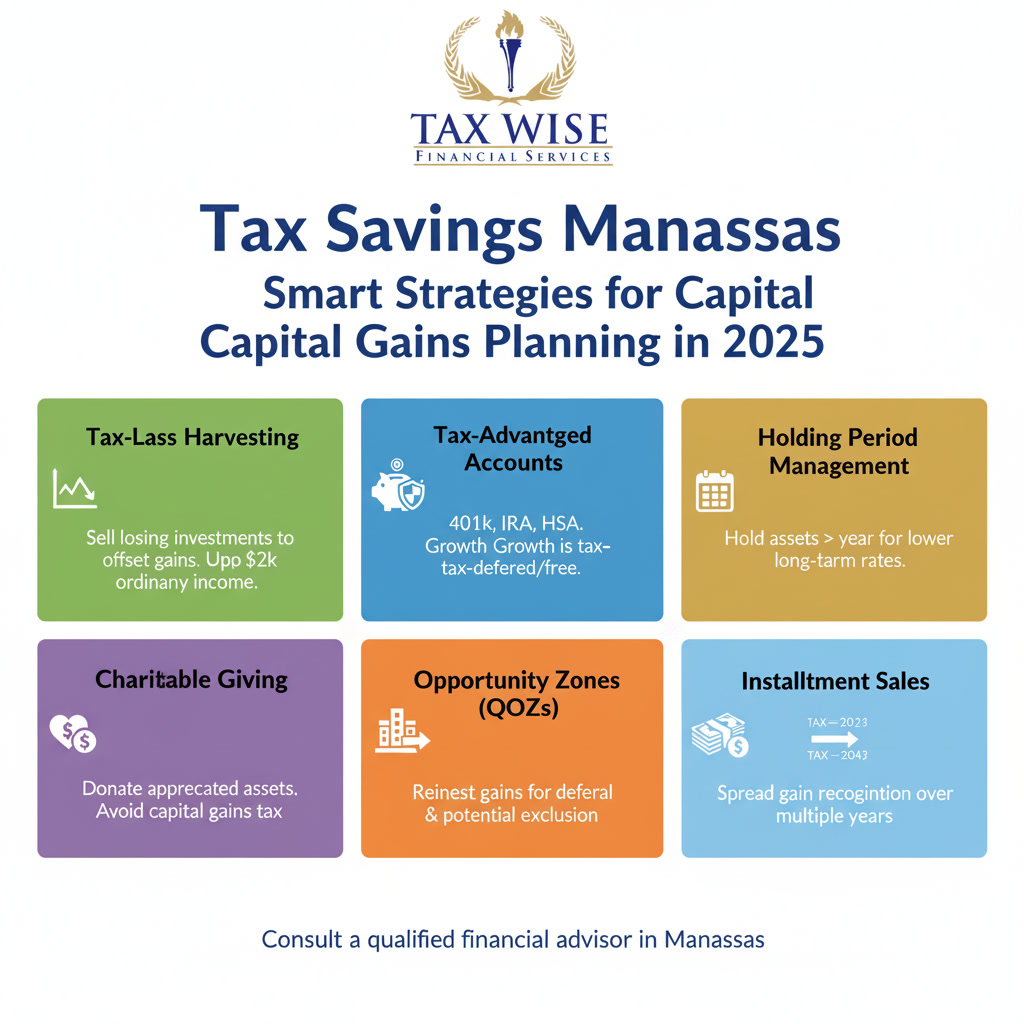
Timing investment decisions with their potential tax consequences in mind
Capital gains taxes can significantly affect the profits you earn from investments, real estate, and other valuable assets. Whether you’re selling stocks, disposing of investment property, or preparing for retirement, understanding how capital gains taxes work can help you make smarter financial decisions.
For individuals, families, and business owners in Manassas, Virginia, effective tax planning involves more than simply calculating how much tax is owed. It requires evaluating when to sell assets, how long to hold investments, and which tax-saving opportunities may apply to your financial situation.
Exploring tax savings Manassas strategies can help investors manage their tax liabilities while working toward long-term financial security.
In this guide, we’ll explain capital gains taxation, explore practical planning strategies, and discuss how thoughtful investment timing can help Manassas residents make more tax-efficient financial decisions in 2025.
Understanding Capital Gains Taxes
Capital gains occur when you sell a capital asset for more than its adjusted tax basis. Common examples include stocks, bonds, mutual funds, investment properties, and certain business assets.
For example, suppose you purchased shares of stock for $20,000 and later sold them for $30,000. Assuming no adjustments to the original purchase price, you would realize a $10,000 capital gain.
However, the amount of tax owed depends on several factors, including your income, filing status, holding period, and the type of asset sold.
Short-Term vs. Long-Term Capital Gains
The Internal Revenue Service (IRS) generally classifies capital gains into two categories.
Short-term capital gains: These arise when you sell an asset held for one year or less. They are generally taxed at ordinary federal income tax rates, which can reach 37% for the 2025 tax year.
Long-term capital gains: These arise when you sell an asset held for more than one year. Most long-term capital gains qualify for preferential federal tax rates of 0%, 15%, or 20%, depending on your taxable income and filing status.
Certain gains, including collectibles gains and some real estate-related gains, may be subject to different rules.
Federal Long-Term Capital Gains Tax Rates for 2025
The following table shows the general federal long-term capital gains income thresholds for the 2025 tax year.
| Filing status | 0% rate | 15% rate | 20% rate |
|---|---|---|---|
| Single | Up to $48,350 | $48,351–$533,400 | Over $533,400 |
| Married filing jointly | Up to $96,700 | $96,701–$600,050 | Over $600,050 |
| Head of household | Up to $64,750 | $64,751–$566,700 | Over $566,700 |
These thresholds are based on taxable income, not simply the amount of investment gains. Capital gains generally stack on top of other taxable income when determining the applicable rate.
Additionally, some higher-income taxpayers may owe the 3.8% Net Investment Income Tax (NIIT).
Understanding these distinctions is essential before making major investment decisions.
Why Capital Gains Planning Matters for Manassas Residents
Manassas investors may hold a combination of retirement savings, brokerage accounts, rental properties, and business interests. Each type of asset can create different tax considerations.
Virginia generally taxes capital gains as part of state taxable income rather than providing a separate preferential rate for long-term gains. As a result, an investment sale may generate both federal and Virginia income tax obligations.
For Manassas residents, effective capital gains planning can help:
- Reduce avoidable tax expenses through lawful strategies.
- Improve after-tax investment returns.
- Coordinate asset sales with retirement planning.
- Manage tax consequences when selling investment properties.
- Make better decisions about portfolio diversification.
- Preserve more wealth for future financial goals.
Successful planning requires understanding how federal and Virginia tax rules interact.
1. Time Investment Sales to Qualify for Long-Term Capital Gains
One of the simplest ways to manage capital gains taxes is to evaluate how long you’ve owned an investment before selling it.
Assets held for more than one year generally qualify for long-term capital gains treatment, which can provide significant federal tax advantages.
Example: How Holding Periods Affect Taxes
Imagine a Manassas investor purchases stock for $15,000 and later sells it for $25,000, generating a $10,000 gain.
If the stock is sold after 10 months, the gain is generally treated as short-term and taxed at ordinary income tax rates.
If the investor waits until the holding period exceeds one year, the gain may qualify for a lower long-term capital gains rate.
For someone in the 24% ordinary federal income tax bracket who qualifies for the 15% long-term capital gains rate, the simplified comparison would be:
| Holding period | Federal tax rate | Tax on $10,000 gain |
|---|---|---|
| 10 months | 24% | $2,400 |
| More than 1 year | 15% | $1,500 |
| Potential federal savings | $900 |
This illustration assumes the entire gain falls within the stated rate brackets and excludes state taxes, NIIT, and other tax effects.
Although waiting can reduce taxes, investment decisions should also consider market volatility, liquidity needs, and financial objectives.
2. Use Tax-Loss Harvesting to Offset Capital Gains
Tax-loss harvesting involves selling investments that have declined in value to realize capital losses that can offset taxable capital gains.
For example, suppose you realize a $12,000 gain from selling one investment but incur a $5,000 loss from selling another.
Your net capital gain would generally be reduced to $7,000, assuming the losses are deductible and no other adjustments apply.
This strategy can be particularly useful for investors who regularly rebalance their portfolios.
Important Tax-Loss Harvesting Rules
Before implementing this approach, consider the following:
- Capital losses generally offset capital gains.
- If capital losses exceed capital gains, individuals can generally deduct up to $3,000 of net capital losses against other income annually, or $1,500 if married filing separately.
- Unused capital losses may generally be carried forward to future tax years.
- The wash-sale rule may disallow a loss when substantially identical securities are purchased within 30 days before or after a loss sale.
Tax-loss harvesting should support your investment strategy rather than encourage unnecessary trading.
For residents seeking tax savings Manassas opportunities, reviewing unrealized gains and losses before year-end can be a valuable part of the planning process.
3. Consider Your Income Before Realizing Capital Gains
Your taxable income can influence the federal capital gains rate applied to your investments.
For instance, a taxpayer with relatively low taxable income may qualify for the 0% federal long-term capital gains rate on some or all eligible gains.
This makes income timing particularly important for retirees, individuals transitioning between jobs, and business owners with fluctuating annual earnings.
Identify Lower-Income Years
Consider evaluating investment sales during years when:
- You retire or temporarily reduce your working hours.
- Your business income is lower than usual.
- You take an extended career break.
- You have significant eligible deductions.
- Your household income changes.
A lower-income year may create opportunities to realize long-term gains at more favorable federal tax rates.
However, realizing additional gains can affect other financial considerations, including Medicare premiums, taxation of Social Security benefits, and eligibility for certain income-based benefits or tax credits.
Coordinating capital gains with your broader tax picture is essential.
4. Understand Capital Gains Taxes on Real Estate
Real estate transactions can generate substantial capital gains, especially when property values have increased over time.
Homeowners and real estate investors in Manassas should understand the difference between selling a primary residence and selling an investment property.
Selling Your Primary Residence
Under IRS Section 121, eligible homeowners may exclude up to:
- $250,000 in gains for qualifying single filers.
- $500,000 in gains for qualifying married couples filing jointly.
Generally, taxpayers must satisfy ownership and use requirements, including owning and using the property as their main home for at least two of the five years before the sale.
Additional restrictions and exceptions may apply.
For example, if a married couple purchased a qualifying home for $350,000 and sold it for $600,000, their $250,000 gain could potentially be fully excluded from federal income tax, assuming all applicable requirements are met and ignoring selling costs and basis adjustments for simplicity.
Selling Rental or Investment Property
Investment properties are treated differently from primary residences.
Potential tax considerations include:
- Capital gains on appreciation.
- Depreciation-related tax consequences.
- Federal and Virginia income taxes.
- Possible Net Investment Income Tax.
- Eligibility for a Section 1031 like-kind exchange.
A properly structured 1031 exchange may allow qualifying investors to defer certain gains when exchanging investment or business real property for other qualifying real property.
Strict identification, timing, and other requirements apply.
Because real estate transactions can involve significant tax liabilities, consulting a qualified tax professional before selling is often beneficial.
5. Take Advantage of Tax-Advantaged Investment Accounts
Tax-advantaged retirement accounts can help investors reduce or defer taxes on investment growth.
Traditional IRAs, Roth IRAs, and employer-sponsored retirement plans offer different tax benefits.
Traditional IRAs and 401(k) Plans
Investments held within traditional retirement accounts generally grow tax-deferred. Selling stocks or mutual funds inside these accounts usually does not trigger immediate capital gains taxes.
However, withdrawals are generally taxed under ordinary income tax rules, rather than preferential long-term capital gains rates.
Roth IRAs
Roth IRAs offer another potential advantage.
Qualified withdrawals, including investment earnings, are generally tax-free. This can make Roth accounts useful for long-term wealth-building strategies.
Investors should evaluate contribution limits, income restrictions, withdrawal requirements, and their expected future tax brackets before choosing an account.
6. Consider Charitable Giving as a Capital Gains Strategy
Charitable donations can be an effective component of capital gains planning for individuals who already intend to support nonprofit organizations.
Rather than selling appreciated securities and donating the proceeds, taxpayers may benefit from donating eligible appreciated investments directly to a qualified charity.
Potential Benefits of Donating Appreciated Securities
Depending on the circumstances, this approach may:
- Avoid recognizing capital gains on donated securities.
- Provide a potential charitable deduction for taxpayers who itemize.
- Support charitable organizations and community initiatives.
- Help reduce concentrated investment positions.
For example, suppose an investor purchased stock for $5,000, and its market value increased to $15,000.
Donating the appreciated shares directly to a qualified charity may allow the investor to avoid realizing the $10,000 gain that would otherwise arise from selling those shares.
The amount of any charitable deduction depends on several factors, including the asset’s holding period, the recipient organization, adjusted gross income limits, and applicable substantiation requirements.
7. Coordinate Capital Gains With Year-End Tax Planning
Tax planning should be an ongoing process rather than an activity reserved for tax filing season.
For individuals seeking tax savings Manassas strategies, reviewing investment activity before December 31 can reveal opportunities to manage taxable gains.
Year-End Capital Gains Planning Checklist
Before the tax year closes, consider reviewing:
- Realized gains: Calculate profits from investments already sold.
- Unrealized losses: Identify investments that may provide legitimate tax-loss harvesting opportunities.
- Holding periods: Determine whether waiting to sell could qualify an investment for long-term treatment.
- Income projections: Estimate your taxable income and applicable capital gains brackets.
- Charitable contributions: Evaluate eligible donations of appreciated assets.
- Estimated tax payments: Determine whether investment gains may require additional payments.
- Investment goals: Ensure tax decisions remain consistent with your overall financial plan.
Remember that transactions completed after December 31 generally fall into the following tax year. The applicable trade date, transaction type, and settlement rules should be considered when planning near year-end.
8. Work With a Tax Professional in Manassas
Capital gains planning can become complicated when multiple investments, business interests, or real estate transactions are involved.
A qualified CPA or tax advisor familiar with Virginia taxation can help evaluate your circumstances and identify applicable planning opportunities.
Professional guidance may be particularly useful when:
- Selling a rental property or business.
- Exercising employee stock options.
- Receiving a large inheritance.
- Managing substantial investment gains.
- Preparing for retirement.
- Planning charitable gifts involving appreciated assets.
A tax professional can also help determine whether the Net Investment Income Tax, estimated tax requirements, or additional reporting obligations apply.
The objective is not simply to reduce taxes in one year. It is to develop a coordinated strategy that supports long-term financial stability.
Frequently Asked Questions About Capital Gains Planning in Manassas
How can I reduce capital gains taxes in Virginia?
Potential strategies include holding eligible investments for more than one year, offsetting gains with deductible investment losses, donating appreciated securities, and realizing gains during lower-income years. Virginia’s state income tax treatment should also be considered.
Does Virginia have a separate long-term capital gains tax rate?
No. Virginia generally includes taxable capital gains in its state income tax calculation and does not offer the same preferential long-term capital gains rates available under federal law.
Can I avoid capital gains taxes when selling my home in Manassas?
Eligible homeowners may exclude up to $250,000 in gains, or up to $500,000 for qualifying married couples filing jointly, when selling a primary residence. Ownership, residence, and other eligibility requirements apply.
What happens if I sell investments at a loss?
Deductible capital losses can offset capital gains. If losses exceed gains, eligible individuals may deduct a limited amount against other income and carry forward remaining losses, subject to IRS rules.
When is the best time to sell an investment for tax purposes?
The ideal timing depends on your holding period, taxable income, investment objectives, and market conditions. Selling after an investment qualifies for long-term capital gains treatment may reduce federal taxes, but tax considerations should not be the only factor.
Conclusion: Make Capital Gains Planning Part of Your Financial Strategy
Capital gains planning is an important part of managing investments and building long-term financial security. By understanding holding periods, evaluating income levels, using tax-loss harvesting appropriately, and taking advantage of available tax provisions, investors can make more informed decisions.
For individuals and business owners exploring tax savings Manassas opportunities, proactive planning can help reduce unnecessary tax exposure while supporting broader financial goals.
The key is to consider potential tax consequences before making major investment decisions rather than waiting until tax filing season.
Whether you’re preparing to sell stocks, transfer investment property, or plan for retirement, working with a qualified tax professional can help you evaluate the options available under federal and Virginia tax laws.
Take control of your financial future by making tax-efficient investment planning a regular part of your wealth management strategy.
Suggested Internal Links
Tax Planning Tips from a Manassas CPA in 2025
Planning Strategies to Consider Before Income Pushes You Into a Higher Tax Bracket in 2025
Tax Savings Manassas for Small Business Owners in 2025
External Link
IRS – Topic No. 409: Capital Gains and Losseshttps://www.irs.gov/taxtopics/tc409
This official IRS resource provides guidance on capital gains classifications, applicable federal tax rates, and reporting requirements.
At TaxWise Corp, we help small business owners across the USA navigate the complex tax landscape, optimize deductions, and protect their financial future. Don’t leave money on the table, start planning today!
Contact TaxWise Corp to schedule your 2025 Tax Planning Consultation and ensure your business saves every possible dollar.