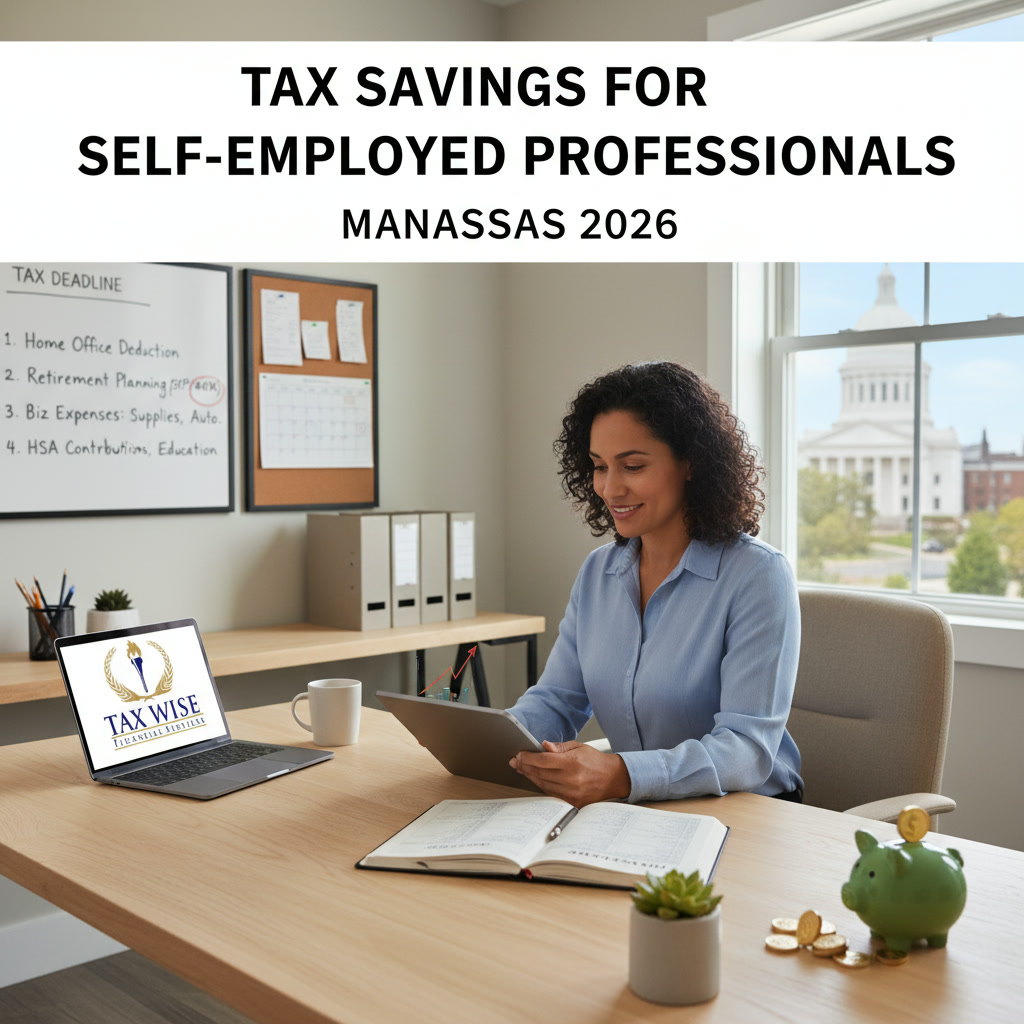
Comparing deductible business expenses, retirement contributions, and self-employment tax obligations
Being your own boss offers freedom, flexibility, and the opportunity to build a successful business. However, self-employment also brings financial responsibilities, particularly when it comes to taxes.
For freelancers, independent contractors, consultants, and small business owners in Manassas, Virginia, understanding available deductions and tax obligations can make a significant difference in annual profitability.
The good news? With proper planning, tax savings in Manassas are achievable through legitimate business deductions, retirement contributions, and effective tax management.
Whether you’re a freelance designer, real estate professional, IT consultant, or independent service provider, this guide explains practical strategies to reduce your taxable income, manage self-employment taxes, and strengthen your financial future in 2026.
Understanding Self-Employment Taxes in Manassas, Virginia
Before exploring tax-saving opportunities, it’s essential to understand how self-employment taxes work.
Unlike traditional employees, whose employers withhold federal income taxes, Social Security, and Medicare contributions, self-employed professionals generally handle these responsibilities themselves.
Depending on your business structure and circumstances, you may be responsible for:
- Federal income tax
- Virginia state income tax
- Self-employment tax covering Social Security and Medicare
- Federal and Virginia estimated tax payments
- Applicable local business license taxes and fees
How Much Is Self-Employment Tax in 2026?
The standard federal self-employment tax rate is 15.3%, consisting of:
- 12.4% for Social Security
- 2.9% for Medicare
Generally, the tax applies to 92.35% of net self-employment earnings rather than gross business revenue.
For 2026, the Social Security portion applies to the first $184,500 of combined earnings subject to the Social Security wage base. Medicare tax generally continues beyond that limit.
Higher-income individuals may also owe an additional 0.9% Medicare tax when applicable income exceeds the relevant filing-status threshold.
Fortunately, self-employed taxpayers generally can deduct the employer-equivalent portion of their self-employment tax when calculating adjusted gross income.
This deduction can reduce federal taxable income, although it does not directly reduce the self-employment tax itself.
Understanding these distinctions is the foundation of effective tax planning.
1. Maximize Deductible Business Expenses
One of the most accessible approaches to tax savings in Manassas involves identifying and documenting eligible business expenses.
The Internal Revenue Service generally allows deductions for business expenses that are ordinary and necessary.
An ordinary expense is common and accepted within your industry. A necessary expense is helpful and appropriate for operating your business.
Common Business Expenses You May Deduct
Depending on your profession, deductible expenses may include:
Office equipment and supplies
- Computers, monitors, and printers
- Business software and subscriptions
- Office furniture
- Professional stationery and supplies
- Equipment maintenance
Marketing and advertising
- Website hosting and maintenance
- Digital advertising campaigns
- Business cards and promotional materials
- Search engine optimization services
- Business-related marketing subscriptions
Professional services
- Accounting and bookkeeping fees
- Business-related legal services
- Tax preparation fees attributable to business activities
- Professional consulting services
Business operations
- Commercial office rent
- Business insurance premiums
- Eligible professional licenses
- Business-related telephone and internet expenses
- Work-related training that maintains or improves existing professional skills
The deductibility of individual expenses depends on their business purpose, applicable tax rules, and supporting documentation.
Home Office Deduction
Many self-employed professionals in Manassas operate from home.
If part of your residence qualifies as a home office, you may be eligible to deduct certain expenses.
Generally, a qualifying home office must be used regularly and exclusively for business, although special exceptions exist for qualifying daycare and inventory storage activities.
Two calculation methods are available:
Simplified method: Deduct $5 per qualifying square foot, up to 300 square feet, for a maximum of $1,500 annually, subject to applicable limitations.
Actual expense method: Calculate the qualifying business-use portion of eligible expenses, potentially including utilities, insurance, repairs, mortgage interest, rent, and depreciation.
For example, a self-employed graphic designer using a qualifying 200-square-foot home office for the entire year could potentially claim a $1,000 deduction under the simplified method.
Choosing between these methods depends on your workspace, expenses, and individual circumstances.
Vehicle and Business Travel Deductions
If you drive to meet clients, visit job sites, or purchase business supplies, qualifying vehicle expenses may also be deductible.
For 2026, the IRS standard business mileage rate is:
- 72.5 cents per mile for January 1 through June 30
- 76 cents per mile for July 1 through December 31
For example, 4,000 qualifying business miles driven entirely during the second half of 2026 could produce a $3,040 mileage deduction.
You must maintain accurate mileage records and distinguish deductible business travel from ordinary commuting.
Depending on eligibility, you may instead calculate deductible actual vehicle expenses. The rules for choosing or changing methods should be reviewed before making that election.
2. Reduce Taxable Income Through Retirement Contributions
Retirement planning is more than preparation for the future. It can also provide valuable tax benefits today.
Self-employed professionals often have access to retirement plans specifically designed for independent business owners.
SEP IRA: A Flexible Option for Independent Professionals
A Simplified Employee Pension Individual Retirement Arrangement (SEP IRA) is popular among freelancers and small business owners because of its relatively straightforward administration.
Potential benefits include:
- Tax-deductible traditional SEP contributions
- Flexible annual employer contributions
- Tax-deferred investment growth
- Relatively simple plan administration
For 2026, the maximum SEP contribution is generally $72,000, subject to the applicable compensation-based limits.
For self-employed individuals, the effective contribution calculation differs from simply taking 25% of Schedule C profit because net earnings must be adjusted under IRS rules.
A SEP IRA may be particularly attractive to professionals with fluctuating annual income.
However, business owners with eligible employees must also consider contribution requirements for those employees.
Solo 401(k): Potentially Higher Contributions
A Solo 401(k), also called a one-participant 401(k), is generally designed for self-employed individuals with no employees other than a spouse.
It allows eligible business owners to make contributions in two capacities:
- As an employee through elective salary deferrals.
- As an employer through eligible employer contributions.
For 2026, the regular employee elective deferral limit is $24,500.
Eligible participants age 50 and older may generally make additional catch-up contributions. For those ages 60 through 63, special higher catch-up limits may apply.
The overall defined contribution limit for 2026 is $72,000 before qualifying catch-up contributions, subject to compensation and other plan rules.
A Solo 401(k) may provide greater contribution opportunities than a SEP IRA at certain income levels.
However, contribution limits can interact with other employer retirement plans, and additional reporting responsibilities may apply.
Traditional IRA and Roth IRA Options
Self-employed professionals can also consider individual retirement accounts.
For 2026:
- The standard IRA contribution limit is $7,500.
- Eligible individuals age 50 or older may contribute an additional $1,100.
- Traditional IRA contributions may be deductible depending on eligibility and income.
- Roth IRA contributions are not deductible, but qualified withdrawals can be tax-free.
Choosing the appropriate retirement account should involve both immediate tax considerations and long-term financial goals.
3. Understand the Qualified Business Income Deduction
The Qualified Business Income (QBI) deduction is another potentially significant opportunity for tax savings in Manassas.
Eligible owners of sole proprietorships, partnerships, and S corporations may qualify for a federal deduction of up to 20% of qualified business income.
The deduction was made permanent under federal legislation enacted in 2025.
How Does the QBI Deduction Work?
Consider a hypothetical self-employed consultant with $80,000 in annual qualified business income.
A simple 20% calculation would equal $16,000.
However, the actual deduction may differ because of taxable-income limitations, business classifications, retirement deductions, and other adjustments.
Additional restrictions can apply to higher-income taxpayers, particularly those operating specified service trades or businesses.
Importantly, the QBI deduction generally reduces federal income tax calculations but does not reduce net earnings used to calculate self-employment tax.
For eligible professionals, coordinating business deductions, retirement contributions, and the QBI deduction can create meaningful tax benefits.
4. Manage Quarterly Estimated Tax Payments
One of the most common mistakes self-employed individuals make is waiting until tax season to calculate what they owe.
Because employers generally do not withhold taxes from self-employment income, business owners may need to make estimated payments throughout the year.
Federal Estimated Tax Deadlines for 2026
The standard federal estimated tax payment deadlines for tax year 2026 are:
- April 15, 2026
- June 15, 2026
- September 15, 2026
- January 15, 2027
These dates apply to calendar-year taxpayers under the general rules.
Estimated payments typically cover both federal income tax and self-employment tax.
Failure to pay sufficient estimated taxes by applicable deadlines may result in underpayment penalties.
How Much Should You Set Aside?
A common budgeting practice is to reserve approximately 25%–35% of net business earnings for taxes.
However, this is only a general planning range, not an IRS requirement.
Your actual needs depend on:
- Annual net business profit
- Filing status
- Other household income
- Available deductions and credits
- State income tax obligations
- Additional Medicare tax exposure
Business owners should calculate their estimated obligations using IRS worksheets or professional assistance.
Maintaining a separate savings account for tax payments can help prevent cash-flow problems.
5. Consider Virginia State and Manassas Local Tax Requirements
Federal taxes are only one part of the financial picture.
Self-employed professionals living or operating businesses in Manassas should also understand Virginia income taxes and any applicable local business requirements.
Virginia State Income Tax
Virginia generally begins its individual income tax calculation with federal adjusted gross income, then applies state-specific adjustments.
The state uses graduated individual income tax rates, with the highest marginal rate currently at 5.75%.
Federal business deductions that affect adjusted gross income may influence Virginia income taxes, although state conformity rules and adjustments can change the final result.
Virginia also has its own estimated tax payment requirements.
Reviewing federal and state obligations together can help prevent unexpected tax balances.
Manassas Business License Requirements
Businesses physically operating within the independent City of Manassas may be subject to local business licensing and Business, Professional and Occupational License (BPOL) requirements.
Local requirements can depend on business activity, location, classification, and gross receipts.
Importantly, the City of Manassas and Prince William County are separate jurisdictions. A Manassas mailing address does not necessarily establish that a business operates within city limits.
Self-employed professionals should confirm the correct locality before applying for licenses or calculating local taxes.
Failing to account for local requirements can create compliance problems that offset otherwise successful tax-planning efforts.
6. Compare Tax Strategies Before Making Financial Decisions
Not every tax strategy provides the same benefit.
Understanding how different deductions affect your tax calculation helps you prioritize effectively.
| Tax Strategy | Primary Benefit | Important Consideration |
|---|---|---|
| Business expense deductions | May reduce business profit and associated taxes | Expenses must qualify and be documented |
| Home office deduction | May reduce taxable business profit | Strict eligibility requirements apply |
| Traditional SEP IRA | Can reduce federal taxable income | Contributions are subject to plan limits |
| Traditional Solo 401(k) | Offers retirement savings and potential tax deductions | Rules vary by contribution type |
| QBI deduction | May reduce federal income tax | Does not directly reduce self-employment tax |
| Estimated tax planning | Helps manage cash flow and avoid penalties | Requires regular income projections |
For example, purchasing unnecessary equipment solely to obtain a deduction rarely makes financial sense.
A $1,000 deductible purchase does not produce $1,000 in tax savings.
If a deduction reduces income subject to a hypothetical 24% marginal income tax rate, the federal income tax benefit would be approximately $240, ignoring other effects.
The business still spends $1,000.
The goal should always be to make economically sound decisions while claiming the tax benefits legitimately available.
7. Explore Whether an S Corporation Election Makes Sense
Some profitable self-employed businesses consider electing S corporation tax treatment.
Depending on the circumstances, this structure may offer opportunities to manage employment taxes.
An eligible S corporation owner who works in the business generally must receive reasonable compensation for services performed.
That compensation is subject to applicable payroll taxes.
Additional eligible profits distributed to the owner may receive different employment tax treatment.
However, an S corporation is not automatically the best option.
Potential disadvantages include:
- Payroll administration costs
- Additional tax return preparation fees
- More extensive bookkeeping requirements
- State registration and compliance obligations
- Reasonable compensation requirements
For professionals earning modest profits, the additional costs may outweigh potential tax benefits.
A qualified tax professional can compare projected savings against administrative expenses before an election is made.
8. Maintain Accurate Financial Records Throughout the Year
Consistent bookkeeping is one of the simplest ways to improve tax accuracy.
Incomplete records can cause business owners to miss legitimate deductions, overstate expenses, or struggle during tax preparation.
Essential Recordkeeping Practices
Consider implementing these habits:
- Maintain separate business and personal bank accounts.
- Record business income and expenses regularly.
- Save digital copies of receipts and invoices.
- Track business mileage with a reliable system.
- Reconcile financial accounts every month.
- Review profit and loss statements quarterly.
- Document the business purpose of significant purchases.
- Keep records supporting retirement contributions and estimated payments.
Accounting software can simplify these responsibilities and provide a clearer picture of profitability.
A well-organized financial system also makes it easier to prepare accurate estimates and respond to documentation requests.
9. Work With a Tax Professional Familiar With Manassas Businesses
Although online tax software can handle many straightforward returns, complex self-employment situations may benefit from professional guidance.
An experienced CPA, enrolled agent, or qualified tax advisor can help evaluate:
- Deduction eligibility
- Retirement plan options
- Estimated tax calculations
- Business entity structure
- Federal and Virginia tax compliance
- Manassas-area licensing requirements
- Long-term financial planning opportunities
Professional advice may be especially valuable when your income increases, you hire employees, purchase substantial equipment, or expand into additional locations.
When Should You Schedule a Tax Planning Consultation?
Ideally, tax planning should occur before the end of the tax year.
Waiting until filing season may limit some opportunities because certain elections, business expenditures, and retirement decisions have specific deadlines.
A midyear review and another assessment during the final quarter can help you adjust your strategy as business conditions change.
10. Frequently Asked Questions
What are the best tax deductions for self-employed professionals in Manassas?
Common opportunities include eligible office expenses, software subscriptions, professional fees, business travel, insurance, and qualifying home office expenses.
The most valuable deductions depend on your business activity and actual expenditures.
Can I deduct health insurance premiums if I am self-employed?
Eligible self-employed individuals may be able to deduct qualifying health insurance premiums for themselves and certain family members.
This deduction is subject to specific requirements, including earned-income limitations and eligibility for other employer-sponsored health coverage.
Does contributing to a retirement account reduce self-employment tax?
Traditional deductible retirement contributions generally reduce income subject to federal income tax, but they typically do not directly reduce the net earnings used to calculate self-employment tax.
Do freelancers need to pay quarterly taxes?
Many freelancers must make estimated tax payments when they expect to owe sufficient tax after accounting for withholding and credits.
Individual circumstances and IRS safe-harbor rules determine whether payments are required.
Can I claim business expenses without forming an LLC?
Yes. Eligible sole proprietors can deduct ordinary and necessary business expenses without establishing an LLC.
An LLC is a legal business structure, not a prerequisite for claiming legitimate business deductions.
Final Thoughts: Build a Smarter Tax Strategy for 2026
Successful tax planning is not about finding shortcuts. It is about understanding the rules, maintaining accurate records, and making informed financial decisions.
For freelancers, consultants, independent contractors, and business owners, maximizing tax savings in Manassas requires a coordinated approach.
That includes:
- Claiming eligible business expense deductions
- Evaluating retirement contribution opportunities
- Understanding federal self-employment tax obligations
- Considering the qualified business income deduction
- Making estimated tax payments on time
- Following Virginia and applicable local tax requirements
- Reviewing business structure and financial records regularly
Every self-employed professional’s tax situation is different. Strategies that benefit one business may offer limited advantages to another.
By planning proactively and obtaining qualified guidance when needed, you can improve tax efficiency, protect business cash flow, and build a stronger financial foundation.
Ready to improve your tax strategy? Schedule a consultation with a qualified tax professional familiar with Manassas and Virginia small businesses to identify appropriate deductions, review retirement options, and prepare for your 2026 tax obligations.
External Source:
City of Manassas Official Website — Local licensing and business-tax information.
IRS: Self-Employment Tax — Tax rates and the 2026 Social Security wage base. Internal Revenue Service
IRS: 2026 Retirement Contribution Limits — Current retirement contribution thresholds. Internal Revenue Service
IRS: Standard Mileage Rates — Business mileage rates, including the two 2026 periods. Internal Revenue Service
Virginia Tax: Estimated Tax Payments — State estimated tax requirements. Virginia Tax
Internal Links
- CPA Near Me in Manassas Helps Small Business Owners Save Thousands on Taxes in 2025
- Top Tax Planning Moves for Consultants and Freelancers in 2025
- CPA Near Me in Manassas, VA for Contractors and Tradespeople in 2025: Bookkeeping, Taxes & Depreciation Explained
At TaxWise Corp, we help small business owners across the USA navigate the complex tax landscape, optimize deductions, and protect their financial future. Don’t leave money on the table, start planning today!
Contact TaxWise Corp to schedule your 2025 Tax Planning Consultation and ensure your business saves every possible dollar.