Comparing how different business structures can affect taxes for growing owners
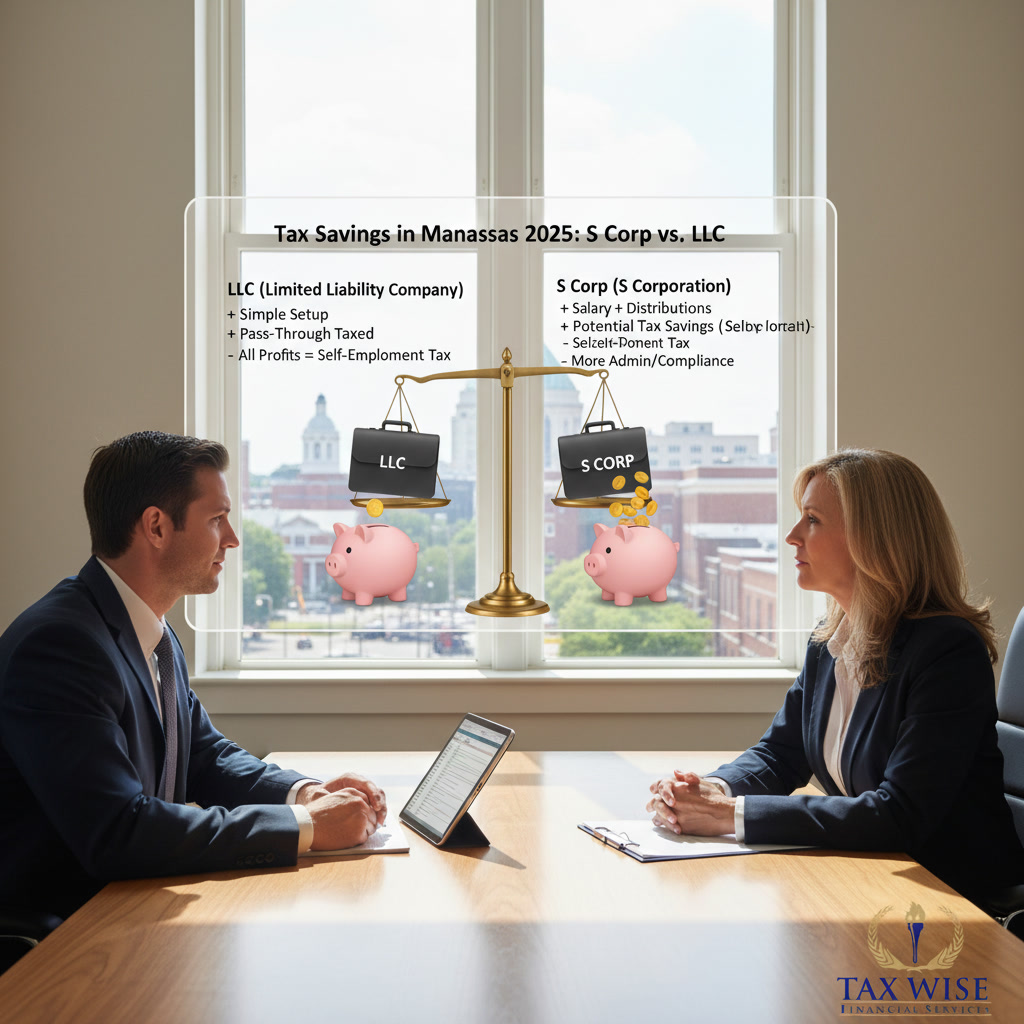
Tax savings Manassas business owners can achieve often depend on one critical decision: choosing the right business tax structure. Whether you operate a consulting firm, retail store, construction company, or professional service business in Manassas, Virginia, understanding the differences between an S Corporation and a Limited Liability Company (LLC) can help you manage taxes more effectively.
Both business structures offer advantages, but they differ in how owners report income, pay employment taxes, handle compensation, and meet federal and state compliance requirements.
For growing businesses, these differences can affect profitability, cash flow, and long-term financial planning.
In this guide, we explore how S Corporation taxation compares with default LLC taxation, potential tax-saving opportunities, and the important factors Manassas business owners should consider before choosing a structure.
Understanding S Corporations and LLCs
Choosing the right business structure starts with understanding how each option operates.
What Is an LLC?
A Limited Liability Company is a legal business entity that generally provides personal liability protection for its owners while offering flexible management and taxation options.
An LLC can have one owner or multiple owners.
For federal income tax purposes, a single-member LLC is generally treated as a sole proprietorship unless it elects another classification. A multi-member LLC is generally taxed as a partnership unless it makes a different election.
Common LLC advantages include:
- Flexible management and ownership arrangements.
- Pass-through federal income taxation under default classifications.
- Relatively straightforward administrative requirements.
- Liability protection, subject to applicable legal exceptions.
- The ability to elect S Corporation taxation if eligible.
For startups and small businesses in Manassas, an LLC can be an attractive option because of its flexibility and relatively simple management requirements.
What Is an S Corporation?
An S Corporation is a federal tax classification available to eligible corporations and LLCs.
Unlike an LLC, S Corporation status is not itself a separate type of Virginia business entity.
A qualifying business can generally elect S Corporation treatment by filing IRS Form 2553.
Under S Corporation taxation, business income generally passes through to shareholders, who report it on their individual income tax returns.
A major potential advantage is that qualifying pass-through profits generally are not subject to self-employment tax.
However, shareholder-employees who perform services for the business must receive reasonable compensation, subject to applicable payroll taxes.
This creates an opportunity for certain profitable businesses to reduce employment tax expenses.
Tax Savings Manassas: S Corporation vs LLC Tax Comparison
The biggest differences between these structures involve self-employment taxes, payroll requirements, administrative costs, and ownership flexibility.
| Tax factor | Default-taxed LLC | S Corporation taxation |
|---|---|---|
| Federal income tax | Generally passes through to owners | Generally passes through to shareholders |
| Self-employment tax | Generally applies to active sole proprietors’ net earnings | Generally does not apply to pass-through profits |
| Owner compensation | Owner draws are generally not wages | Reasonable wages required for working shareholder-employees |
| Payroll requirements | Generally not required for sole owners without employees | Generally required for working shareholder-employees |
| Tax filing | Schedule C or Form 1065, depending on classification | Generally Form 1120-S |
| Administrative costs | Often lower | Often higher |
| Ownership flexibility | Generally greater | Subject to S Corporation eligibility restrictions |
An important point is that an existing LLC may elect S Corporation taxation without necessarily forming a new legal entity.
Therefore, business owners can sometimes obtain the tax treatment of an S Corporation while retaining their LLC’s legal structure.
How S Corporation Taxation Can Reduce Employment Taxes
One of the primary reasons profitable businesses consider S Corporation taxation is the potential reduction in Social Security and Medicare taxes.
Self-Employment Taxes for LLC Owners
For 2025, the basic federal self-employment tax rate is 15.3%, consisting of:
- 12.4% Social Security tax, subject to the annual wage base.
- 2.9% Medicare tax, without the same wage-base limit.
Additional Medicare tax rules may apply to higher-income taxpayers.
A single-member LLC owner taxed as a sole proprietor generally pays self-employment tax on qualifying net earnings from the business.
These taxes are separate from federal and state income taxes.
How S Corporation Owner Compensation Works
S Corporation shareholder-employees must generally receive reasonable compensation for services performed.
That compensation is subject to applicable payroll taxes.
After accounting for reasonable wages, employer payroll taxes, and other expenses, remaining business profits may pass through to shareholders without additional Social Security and Medicare employment taxes.
This distinction can produce meaningful savings when a business earns substantially more than the reasonable compensation required for its owner.
Example of Potential Tax Savings
Consider a Manassas business generating $150,000 in annual profit before owner compensation and employer payroll taxes.
Suppose an analysis of the owner’s responsibilities, experience, and comparable market compensation supports an $80,000 annual salary.
The simplified financial breakdown would look like this:
| Description | Amount |
|---|---|
| Business profit before owner compensation | $150,000 |
| Reasonable owner salary | $80,000 |
| Remaining before employer payroll taxes and other adjustments | $70,000 |
The $80,000 salary would generally be subject to applicable payroll taxes.
The remaining profit, after employer payroll taxes and other adjustments, could potentially qualify as pass-through income not subject to self-employment tax.
However, the actual savings are not simply 15.3% of $70,000. They depend on self-employment tax calculations, Social Security wage-base limits, income tax effects, other earnings, and administrative costs.
This example illustrates why an individualized calculation is important.
LLC Tax Advantages for Growing Manassas Businesses
Although S Corporation taxation can provide benefits, an LLC with default taxation may be more suitable for some owners.
Simpler Tax Reporting
A single-member LLC taxed as a sole proprietorship generally reports business income and expenses using Schedule C.
This can be simpler than preparing a separate S Corporation income tax return and managing payroll.
Lower Administrative Expenses
S Corporations often incur additional costs for:
- Payroll processing.
- Tax return preparation.
- W-2 and payroll tax reporting.
- Accounting and bookkeeping.
- Ongoing compliance administration.
For smaller businesses, these costs may outweigh potential employment tax savings.
Flexibility for Multiple Owners
LLCs taxed as partnerships generally provide greater flexibility in structuring ownership and certain profit allocations.
S Corporations face restrictions on eligible shareholders and stock classes.
For businesses planning to add investors or establish complex ownership arrangements, an LLC taxed as a partnership may offer greater flexibility.
Virginia Tax Rules and Local Manassas Requirements
Federal tax savings are only one part of the decision.
Business owners must also consider Virginia income taxes and applicable local business obligations.
Virginia Individual Income Taxes
Virginia generally taxes pass-through business income at the owner level.
For 2025, the highest Virginia individual income tax rate was 5.75%.
Choosing S Corporation taxation does not automatically eliminate Virginia income taxes.
Owners may still owe state income tax on their share of business profits.
Virginia Pass-Through Entity Tax Election
Virginia offers an elective Pass-Through Entity Tax (PTET) for qualifying businesses.
For 2025, eligible entities could elect to pay Virginia income tax at the entity level at a rate of 5.75%, with qualifying owners receiving corresponding state tax credits.
Depending on applicable federal rules and individual circumstances, this election may create additional tax-planning opportunities.
Both qualifying partnerships and S Corporations may be eligible.
For official information, visit the Virginia Department of Taxation’s Pass-Through Entity Tax page.
Manassas Business Licenses and Local Taxes
Businesses operating within the City of Manassas may be subject to business licensing requirements and applicable Business, Professional and Occupational License (BPOL) taxes.
Requirements may vary depending on the business’s activity, location, and gross receipts.
A business located in Prince William County outside the City of Manassas may face different local requirements.
Business owners should verify the rules applicable to their actual operating location.
When Should an LLC Elect S Corporation Taxation?
For business owners evaluating tax savings Manassas opportunities, timing can play a major role in determining whether an S Corporation election makes financial sense.
An S Corporation election may be worth considering when:
- Business profits are consistently strong.
- Profits exceed reasonable owner compensation by a meaningful amount.
- The owner actively works in the business.
- Potential employment tax savings exceed additional compliance expenses.
- The business qualifies under IRS S Corporation rules.
- The owner can maintain accurate payroll and financial records.
There is no universal profit threshold that guarantees S Corporation taxation will be beneficial.
For example, a company earning $40,000 annually may have limited potential savings after reasonable compensation and administrative expenses.
A business generating $200,000 in annual profit may have more flexibility, depending on the owner’s responsibilities and compensation requirements.
The decision should be based on actual financial projections rather than a fixed income target.
Common Tax Mistakes to Avoid
Choosing a business tax structure without understanding its requirements can lead to unnecessary expenses and compliance problems.
Paying an Unreasonably Low Salary
S Corporation owners who work in their businesses cannot simply take all profits as distributions to avoid employment taxes.
The IRS requires reasonable compensation for shareholder-employees providing services.
Salary decisions should reflect actual job responsibilities, industry standards, experience, and other relevant factors.
Ignoring Payroll and Accounting Costs
S Corporation taxation may generate employment tax savings, but those benefits must be compared with payroll processing, accounting, and compliance costs.
Assuming All LLCs Have the Same Tax Treatment
An LLC may be taxed as a sole proprietorship, partnership, C Corporation, or S Corporation, depending on its circumstances and elections.
Understanding the actual tax classification is essential.
Missing IRS Election Deadlines
Businesses generally use Form 2553 to elect S Corporation status.
The usual deadline is two months and 15 days after the beginning of the tax year for which the election is intended, subject to applicable deadline adjustments and late-election relief.
Review the IRS Form 2553 instructions for eligibility and filing requirements.
How Professional Tax Planning Supports Business Growth
Tax planning involves more than selecting an entity classification.
A qualified tax professional can evaluate how the business structure affects employment taxes, deductions, compensation, state taxes, and long-term financial goals.
An effective tax review may include:
- Analyzing annual revenue and business expenses.
- Determining reasonable owner compensation.
- Comparing federal employment taxes.
- Reviewing Virginia income tax and PTET considerations.
- Estimating payroll and accounting expenses.
- Evaluating qualified business income deduction implications.
- Forecasting tax obligations as the business grows.
This approach helps owners make decisions based on overall financial outcomes rather than individual tax rates.
Frequently Asked Questions
Is an S Corporation better than an LLC for tax savings?
Not always. S Corporation taxation may reduce certain employment taxes for qualifying profitable businesses. However, additional payroll and administrative costs can offset the benefits.
Can a Manassas LLC elect S Corporation taxation?
Yes. An eligible LLC can generally elect S Corporation treatment by filing the appropriate IRS paperwork. The LLC may retain its existing legal entity status.
Does an S Corporation pay Virginia income taxes?
S Corporation income generally passes through to shareholders, who report applicable income on their individual returns. Certain qualifying entities may also elect Virginia’s pass-through entity tax.
Are LLC owners required to pay self-employment taxes?
Active owners of single-member LLCs taxed as sole proprietorships generally pay self-employment taxes on qualifying net earnings. Different rules may apply to partnership members and LLCs with corporate tax elections.
Can an S Corporation deduct business expenses?
Yes. S Corporations generally can deduct ordinary and necessary business expenses when applicable tax requirements are satisfied.
Should I hire a CPA before changing my business tax structure?
Consulting a qualified CPA or tax advisor is recommended. A professional can help compare projected tax liabilities, evaluate compensation requirements, and identify potential compliance obligations.
Final Thoughts: Finding the Right Tax Structure in Manassas
Choosing between default LLC taxation and S Corporation taxation can significantly influence a business’s financial position.
An LLC may provide simplicity, flexibility, and lower administrative costs, particularly for new or smaller businesses.
S Corporation taxation may provide employment tax advantages when a business generates sufficient profits above reasonable owner compensation.
However, the best option depends on the owner’s income, business expenses, growth expectations, and compliance requirements.
For entrepreneurs seeking tax savings Manassas solutions, the most effective strategy is to compare both structures using realistic financial projections and professional guidance.
With the right planning, business owners can improve tax efficiency while building a stronger foundation for future growth.
Ready to Review Your Business Tax Strategy?
Consult a qualified Manassas business tax professional to explore whether your LLC’s current tax treatment or an S Corporation election better supports your financial goals.
At TaxWise Corp, we help small business owners across the USA navigate the complex tax landscape, optimize deductions, and protect their financial future. Don’t leave money on the table, start planning today!
Contact TaxWise Corp to schedule your 2025 Tax Planning Consultation and ensure your business saves every possible dollar.