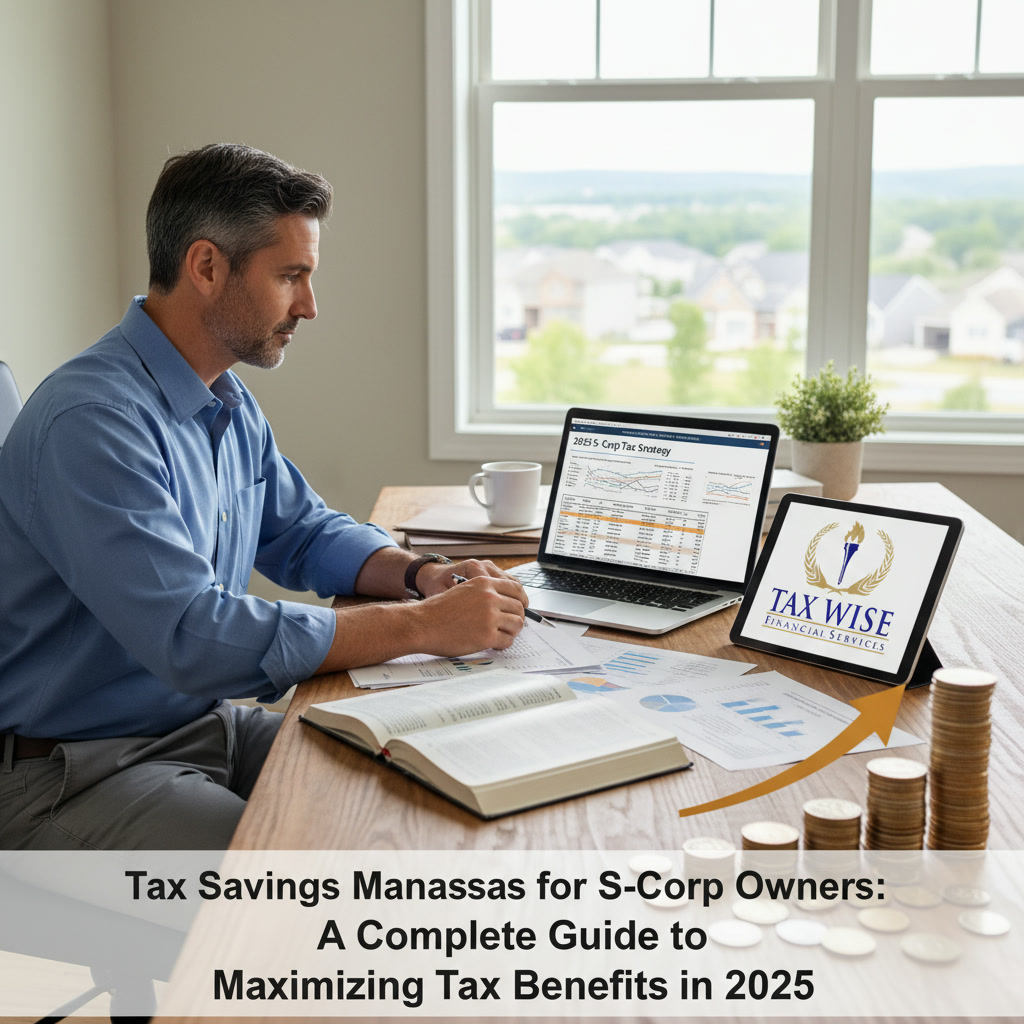
Understanding reasonable compensation, shareholder distributions, and potential payroll tax advantages
Running a successful business in Manassas, Virginia, comes with exciting opportunities—and significant financial responsibilities. For business owners operating as S corporations, one of the most valuable opportunities is the ability to manage taxes strategically while remaining compliant with Internal Revenue Service (IRS) regulations.
Understanding tax savings Manassas for S-Corp owners can help entrepreneurs reduce unnecessary payroll tax expenses, structure compensation effectively, and retain more of their hard-earned profits.
However, maximizing these benefits requires more than simply paying yourself a small salary and taking the remaining profits as distributions. The IRS has specific requirements regarding reasonable compensation, shareholder payments, and payroll taxes.
In this comprehensive guide, we’ll explore how S-Corp taxation works, why reasonable compensation matters, how shareholder distributions may generate payroll tax savings, and which strategies Manassas business owners should consider for the 2025 tax year.
What Is an S Corporation, and How Does It Help Business Owners Save Taxes?
An S corporation, commonly called an S-Corp, is a corporation—or an eligible LLC—that elects special federal tax treatment under Subchapter S of the Internal Revenue Code.
Unlike traditional C corporations, which generally pay corporate income taxes and may distribute dividends that are taxed again at the shareholder level, most S corporations pass their income, losses, deductions, and credits directly to shareholders.
Shareholders then report their respective shares on their individual federal income tax returns.
Key Tax Benefits of an S Corporation
For qualifying businesses, S-Corp status offers several advantages:
- Pass-through taxation: Business income generally passes through to shareholders without a separate federal corporate income tax.
- Potential payroll tax savings: Eligible business profits distributed to shareholders may avoid Social Security and Medicare employment taxes.
- Flexible compensation planning: Shareholder-employees may receive both W-2 wages and shareholder distributions.
- Business expense deductions: Ordinary and necessary business expenses may reduce taxable business income.
- Retirement planning opportunities: Eligible S-Corp owners can establish retirement plans and make qualifying contributions.
- Potential qualified business income deductions: Eligible shareholders may qualify for a deduction under Section 199A, subject to applicable limitations.
These advantages make S-Corp taxation attractive to consultants, contractors, healthcare professionals, professional service providers, and other entrepreneurs throughout Manassas and Northern Virginia.
However, the most important factor in unlocking payroll tax advantages is understanding how compensation and distributions must be handled.
Understanding Reasonable Compensation for S-Corp Owners
One of the most important rules for S-Corp owners is the IRS requirement to pay reasonable compensation to shareholders who perform services for the company.
According to the IRS guidance on S-Corporation compensation, shareholder-employees must receive reasonable compensation for their services before receiving non-wage distributions.
What Does Reasonable Compensation Mean?
Reasonable compensation generally refers to the amount a business would ordinarily pay someone with comparable skills, experience, and responsibilities to perform similar work under comparable circumstances.
For example, imagine you own a marketing agency in Manassas. You perform client consultations, oversee employees, manage advertising campaigns, and handle daily operations.
If a comparable marketing agency manager or executive would normally earn $85,000 annually, paying yourself only $15,000 while taking substantial distributions could raise questions during an IRS examination.
The IRS does not establish one universal salary percentage for S-Corp owners. Instead, compensation must reflect the facts and circumstances of each business.
Factors That Influence Reasonable Compensation
When determining an appropriate salary, business owners should consider:
- Their professional qualifications, training, and experience
- The number of hours they work
- Their primary responsibilities and decision-making authority
- Compensation paid for similar positions in Manassas and Northern Virginia
- The business’s size, financial performance, and operating conditions
- The nature and complexity of services performed
- Compensation arrangements for comparable employees
- The extent to which business earnings result from the owner’s personal services
Owners should also maintain records supporting their salary decisions.
Useful documentation includes job descriptions, compensation surveys, employment agreements, financial statements, and explanations of how the salary was calculated.
Important: Reasonable compensation is not automatically 40%, 50%, or 60% of business profits. A fixed percentage may be convenient, but it does not replace a defensible compensation analysis.
How Shareholder Distributions Can Reduce Payroll Taxes
A major reason entrepreneurs elect S-Corp treatment is the potential difference between the tax treatment of wages and shareholder distributions.
W-2 Salary vs. Shareholder Distributions
When an S-Corp pays wages to a shareholder-employee, those wages are generally subject to federal employment taxes.
For 2025:
- Social Security tax is 12.4% combined, split equally between employee and employer.
- Medicare tax is 2.9% combined, also split equally.
- The Social Security wage base is $176,100.
- Medicare tax generally applies without a wage base limit.
- Additional Medicare Tax may apply to employee wages exceeding applicable income thresholds.
Together, the standard Social Security and Medicare employment tax rates total 15.3% on wages below the Social Security wage base.
By contrast, properly classified S-Corp shareholder distributions are generally not subject to Social Security or Medicare employment taxes.
This difference can create meaningful savings.
However, distributions are not automatically exempt from federal income tax. S-Corp shareholders generally report their allocated business income whether or not that income is distributed. Distributions themselves are generally tax-free only to the extent of available stock basis, subject to applicable exceptions.
Example: Potential Payroll Tax Savings for a Manassas Business Owner
Consider a hypothetical S-Corp owner whose business generates $150,000 before owner compensation and employer payroll taxes.
For illustration, assume a compensation review supports a $90,000 annual salary.
| Compensation Component | Amount |
|---|---|
| Business earnings before owner compensation and employer payroll taxes | $150,000 |
| Reasonable W-2 salary | $90,000 |
| Employer Social Security and Medicare taxes (7.65%) | $6,885 |
| Remaining business profit, before other applicable adjustments | $53,115 |
| Combined employee and employer Social Security and Medicare taxes on salary | $13,770 |
If the entire $150,000 were instead paid as wages, the combined employee and employer Social Security and Medicare taxes would be approximately $22,950.
The difference is approximately $9,180 in combined employment taxes.
This example demonstrates a potential payroll tax advantage—not a guaranteed reduction in total tax liability.
Actual results depend on reasonable compensation, employer deductions, income taxes, other payroll obligations, retirement contributions, shareholder basis, and additional circumstances.
The $53,115 remaining profit is also not necessarily the amount available for distribution because the company may need to retain cash for expenses, taxes, and future operations.
Why S-Corp Owners Must Avoid Unreasonably Low Salaries
While lower wages may appear to generate greater payroll tax savings, minimizing salary without considering IRS requirements can create substantial risks.
The IRS can reclassify shareholder distributions as wages when payments represent compensation for services.
Potential consequences include:
- Additional employment taxes
- Interest on unpaid taxes
- Applicable penalties
- Payroll reporting corrections
- Increased accounting and legal expenses
- Potential IRS examinations
For example, a business owner who performs nearly all revenue-generating services but reports little or no salary while taking large distributions may face heightened scrutiny.
A compliant compensation strategy balances legitimate payroll tax savings against the obligation to pay reasonable wages.
How to Establish a Defensible Salary
Manassas S-Corp owners should consider the following process:
- Identify all services performed for the business.
- Estimate the time dedicated to each responsibility.
- Research compensation for comparable roles in the regional labor market.
- Evaluate the company’s financial circumstances.
- Document the reasons supporting the selected salary.
- Review compensation periodically as responsibilities and business performance change.
Working with a qualified CPA or tax advisor familiar with S corporations can help business owners develop a reasonable approach.
Additional Tax Savings Strategies for Manassas S-Corp Owners
Payroll tax planning is only one component of a broader S-Corp tax strategy.
Entrepreneurs seeking tax savings Manassas for S-Corp owners should also review retirement contributions, business deductions, shareholder benefits, and Virginia-specific tax opportunities.
1. Maximize Eligible Retirement Plan Contributions
S-Corp owners may be able to reduce taxable income through eligible retirement arrangements, including:
- Solo 401(k) plans
- SEP IRAs
- Traditional 401(k) plans
- Other qualifying employer-sponsored retirement plans
The appropriate plan depends on factors such as employee eligibility, compensation, contribution limits, and business structure.
An important consideration is that retirement contributions based on compensation generally depend on eligible W-2 wages—not shareholder distributions.
Therefore, setting an excessively low salary may reduce certain retirement contribution opportunities.
2. Deduct Ordinary and Necessary Business Expenses
Maintaining accurate records of legitimate business expenditures can help reduce taxable business income.
Common deductible expenses may include:
- Office rent and utilities
- Advertising and marketing
- Professional accounting and legal services
- Business software subscriptions
- Eligible vehicle and travel expenses
- Employee compensation and benefits
- Office equipment and supplies
- Qualifying business insurance
The expenses must satisfy applicable IRS deduction requirements.
Accurate bookkeeping is especially important for separating business purchases from personal expenses.
3. Evaluate Health Insurance Deduction Opportunities
S-Corp shareholders who own more than 2% of the company’s stock are subject to special health insurance rules.
Under qualifying circumstances, health insurance premiums paid or reimbursed through the S-Corp may be included in the shareholder’s Form W-2 and potentially qualify for a self-employed health insurance deduction on the individual income tax return.
The correct treatment depends on how the health insurance arrangement is established and reported.
Business owners should coordinate with their payroll provider and tax advisor to avoid reporting errors.
4. Consider Virginia’s Elective Pass-Through Entity Tax
Virginia offers an elective pass-through entity tax (PTET) for qualifying businesses, including eligible S corporations.
For the 2025 tax year, qualifying entities may elect to pay Virginia income tax at the entity level at a rate of 5.75%.
Eligible owners may then receive corresponding Virginia tax credits, subject to applicable rules.
This election may create federal tax advantages in certain situations because qualifying state income taxes paid at the entity level may receive different federal deduction treatment than personally paid state and local income taxes.
However, the financial benefit depends on the owner’s circumstances and applicable federal and Virginia tax provisions.
For official guidance, visit the Virginia Department of Taxation’s Elective Pass-Through Entity Tax page.
5. Review Eligibility for the Qualified Business Income Deduction
The Section 199A qualified business income deduction may provide significant federal income tax benefits for eligible S-Corp shareholders.
For qualifying taxpayers, the deduction can be worth up to 20% of eligible qualified business income, subject to limitations and adjustments.
However, S-Corp shareholder wages are not themselves qualified business income.
The deduction may also be affected by taxable income, the business’s industry, W-2 wages, qualified property, and other factors.
Professional service businesses—including certain healthcare, legal, accounting, and consulting practices—may face additional limitations at higher income levels.
A qualified tax professional can evaluate whether an S-Corp owner qualifies and how compensation decisions may affect the deduction.
Common Tax Planning Mistakes S-Corp Owners Should Avoid
Even profitable businesses can lose money through preventable tax planning mistakes.
Paying No Salary While Taking Distributions
Shareholders who actively provide services generally cannot replace reasonable compensation entirely with distributions.
Mixing Personal and Business Finances
Using business funds for personal purchases without proper accounting can create inaccurate financial records and complicate tax reporting.
Ignoring Shareholder Stock Basis
Distributions exceeding available stock basis may trigger taxable gains. Shareholders should maintain accurate basis records.
Failing to Make Timely Payroll Tax Deposits
S-Corps with employees, including shareholder-employees, generally must comply with applicable payroll withholding, deposit, and reporting obligations.
Overlooking Virginia Tax Requirements
Businesses operating in Manassas may have federal, Virginia, and applicable local tax and licensing obligations.
Waiting Until Tax Filing Season
Effective tax planning often requires decisions throughout the tax year.
Reviewing compensation, withholding, estimated tax obligations, and retirement contributions during the year can help prevent costly surprises.
When Should a Manassas Business Consider S-Corp Taxation?
S-Corp status is not automatically the best choice for every small business.
A business may benefit from evaluating S-Corp taxation when:
- It generates consistent profits beyond what would represent reasonable owner compensation.
- The owner actively participates in business operations.
- Potential employment tax savings may outweigh additional compliance costs.
- The business can maintain accurate payroll and accounting records.
- It satisfies S-Corp shareholder, stock, and eligibility requirements.
However, businesses with modest profits may discover that payroll processing fees, tax preparation expenses, and administrative responsibilities reduce or eliminate potential savings.
For this reason, a comparison of available tax structures should consider total costs—not only potential payroll tax reductions.
Frequently Asked Questions About S-Corp Tax Savings in Manassas
Can S-Corp owners avoid paying self-employment taxes?
An S-Corp shareholder’s distributive share of business income generally is not subject to self-employment tax.
However, shareholder-employees must receive reasonable wages for services performed, and those wages are generally subject to applicable Social Security and Medicare employment taxes.
How much salary should an S-Corp owner pay themselves?
There is no universal salary amount or fixed IRS-approved percentage.
Reasonable compensation depends on responsibilities, hours worked, experience, comparable compensation, and other relevant circumstances.
Are S-Corp distributions tax-free?
Distributions are generally not subject to Social Security and Medicare employment taxes when properly classified.
They are often not separately taxable to the extent of the shareholder’s stock basis. However, shareholders generally pay income tax on their allocated S-Corp earnings, even when those earnings remain in the business.
Can an LLC in Virginia elect S-Corp taxation?
Yes. An eligible LLC may elect S-Corp treatment for federal income tax purposes if it meets applicable IRS eligibility and election requirements.
Does S-Corp status eliminate Virginia income taxes?
No. Although qualifying S corporations generally receive pass-through treatment, shareholders may still owe Virginia individual income taxes on their allocated business income.
Additional state and local obligations may also apply.
Is an S-Corp worth it for a small business in Manassas?
It depends on profitability, reasonable compensation, administrative expenses, and the owner’s broader tax situation.
A personalized tax comparison is the most reliable way to estimate the potential advantage.
How a Manassas Tax Professional Can Help Maximize S-Corp Savings
Tax planning becomes more valuable as a business grows, hires employees, purchases equipment, or changes its compensation structure.
A qualified S-Corp tax professional can help with:
- Reasonable compensation assessments
- Payroll tax compliance
- Shareholder distribution planning
- Business deductions and retirement contributions
- Virginia elective pass-through entity tax considerations
- Federal and state tax return preparation
- Estimated tax planning
- Long-term business tax strategies
An advisor familiar with Virginia tax requirements can also help local entrepreneurs understand how federal tax decisions interact with state obligations.
Final Thoughts: Make S-Corp Tax Planning Work for Your Manassas Business
Understanding tax savings Manassas for S-Corp owners starts with knowing the difference between reasonable compensation and shareholder distributions.
The potential payroll tax advantage of an S-Corp can be meaningful, but it must be supported by accurate payroll records, appropriate shareholder compensation, and careful compliance with IRS requirements.
Business owners should also look beyond payroll taxes and consider retirement plans, deductible business expenses, health insurance arrangements, qualified business income deductions, and Virginia-specific tax elections.
Ultimately, the goal is not simply to minimize payroll taxes. It is to create a sustainable, compliant tax strategy that supports long-term business growth.
Ready to explore potential S-Corp tax savings?
If you own a business in Manassas, Virginia, consider scheduling a consultation with an experienced CPA or qualified tax professional. A personalized review of your business income, salary structure, and tax obligations can help identify legitimate savings opportunities while minimizing unnecessary risks.
Internal links
- Tax Savings Manassas After Selling a Rental Property in 2025
- Tax Prep Manassas for Rental Property Owners in 2025
- eSmart Real Estate Tax Strategies and Depreciation Recapture in 2025
External Links
- IRS — S Corporation Compensation and Medical Insurance Issues
- IRS — S Corporation Stock and Debt Basis
- Virginia Tax — Elective Pass-Through Entity Tax
At TaxWise Corp, we help small business owners across the USA navigate the complex tax landscape, optimize deductions, and protect their financial future. Don’t leave money on the table, start planning today!
Contact TaxWise Corp to schedule your 2025 Tax Planning Consultation and ensure your business saves every possible dollar.