
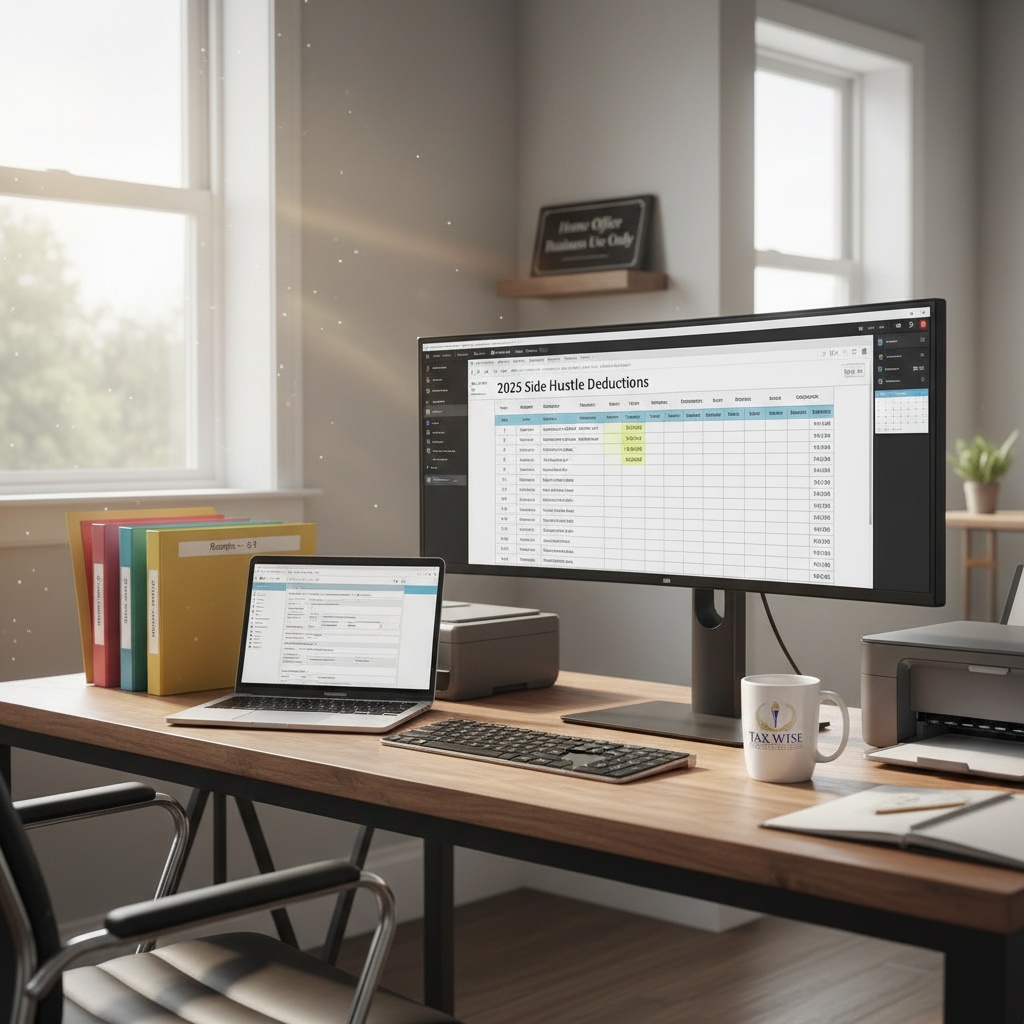
Managing taxes on freelance work, consulting income, and side businesses without costly surprises
Working a full-time job while earning additional income is becoming an increasingly attractive way to build financial security. Whether you provide freelance services, offer consulting expertise, sell products online, or operate a small business, having multiple income streams can help you reach your financial goals faster.
However, additional income also brings additional tax responsibilities.
For W-2 employees in Manassas, Virginia, understanding how side income affects federal and state taxes is essential. Many professionals assume that because their employer already withholds taxes from their paycheck, their side-business income is automatically covered. Unfortunately, that assumption can lead to unexpected tax bills, penalties, and missed deductions.
The good news? With the right planning, you can reduce your tax burden legally while keeping more of your hard-earned money.
This guide explores practical Tax savings Manassas strategies for W-2 employees who earn freelance, consulting, or small-business income in 2025.
Understanding How Side Income Affects Your Taxes
When you work as a W-2 employee, your employer typically withholds federal income tax, state income tax, Social Security tax, and Medicare tax from your paycheck.
Side income generally works differently.
If you earn money through independent contracting, consulting, freelancing, or operating a sole proprietorship, you are generally responsible for reporting that income and paying the applicable taxes yourself.
What Counts as Side Income?
Common examples include:
- Freelance writing, graphic design, or web development
- Business and technology consulting
- Real estate-related services
- Online stores and e-commerce businesses
- Photography and event services
- Tutoring and educational services
- Rideshare driving and delivery services
- Social media management and digital marketing
- Home improvement and repair services
Even if you earn just a few thousand dollars annually, your additional earnings may increase your overall tax liability.
Do You Have to Report Small Amounts of Side Income?
Generally, yes.
The Internal Revenue Service requires taxpayers to report taxable income even when they do not receive a Form 1099-NEC or 1099-K.
For example, if you earn $3,000 from freelance consulting and receive payment directly from clients, that income generally still belongs on your tax return.
Additionally, individuals with net earnings from self-employment of $400 or more generally must calculate and pay self-employment tax.
Maintaining accurate records from the beginning can make reporting easier and reduce the risk of errors.
1. Understand Self-Employment Taxes Before They Become a Surprise
One of the biggest tax challenges for employees with side businesses is self-employment tax.
For 2025, the standard self-employment tax rate is 15.3%, consisting of:
- 12.4% for Social Security
- 2.9% for Medicare
This tax is generally calculated on 92.35% of eligible net self-employment earnings, subject to applicable limits and adjustments.
It is separate from federal and Virginia income taxes.
Example: A Manassas Employee With Freelance Income
Suppose you earn:
- Annual W-2 salary: $75,000
- Freelance consulting revenue: $15,000
- Deductible business expenses: $3,000
- Net freelance profit: $12,000
Your side business has $12,000 in net profit.
Assuming the full standard self-employment tax rate applies, the approximate self-employment tax would be:
$12,000 × 92.35% × 15.3% = $1,696
This amount does not include the additional federal and Virginia income tax associated with your freelance profit.
Fortunately, you can generally deduct the employer-equivalent portion—approximately half—of your self-employment tax when calculating adjusted gross income.
Important: For 2025, the Social Security portion of employment and self-employment taxes generally applies only up to a combined wage base of $176,100. Higher-income employees may therefore have different calculations. Additional Medicare Tax can also apply in certain circumstances.
Understanding these rules helps you estimate your actual tax obligations and plan accordingly.
2. Claim Legitimate Business Expense Deductions
One of the most effective ways to reduce taxable side-business income is to claim eligible business deductions.
The IRS generally allows deductions for ordinary and necessary expenses incurred while operating a trade or business.
An ordinary expense is common and accepted in your industry. A necessary expense is helpful and appropriate for your business.
Common Tax-Deductible Side-Business Expenses
Depending on your activities, deductible expenses may include:
- Office supplies: Paper, printer ink, notebooks, and other business materials
- Software subscriptions: Accounting platforms, design applications, and business-related digital tools
- Professional services: Bookkeeping, legal assistance, and tax preparation related to your business
- Marketing expenses: Website hosting, advertising, business cards, and promotional materials
- Business equipment: Computers, monitors, cameras, and other qualifying equipment
- Professional education: Training that maintains or improves skills used in your existing business
- Business travel: Qualifying transportation, lodging, and related expenses
- Business vehicle expenses: Eligible mileage or actual operating costs attributable to business use
Keep Personal and Business Expenses Separate
A common mistake is claiming the entire cost of an item that serves both personal and business purposes.
For example, if you use a laptop 60% for freelance projects and 40% for personal activities, only the eligible business portion generally qualifies for deduction, subject to applicable tax rules.
Keeping receipts, invoices, and accurate business-use records helps support your deductions.
Pro tip: Open a separate bank account for your side business. While a separate account is not automatically required for every sole proprietor, it makes tracking business transactions significantly easier.
3. Explore the Home Office Deduction
If you operate your side business from home, you may qualify for a home office deduction.
This can be particularly valuable for consultants, freelancers, online business owners, and remote service providers.
However, the deduction comes with specific requirements.
Who Qualifies for a Home Office Deduction?
Generally, the workspace must be used regularly and exclusively for qualifying business purposes.
For example, a dedicated room used exclusively for freelance consulting may qualify if the other requirements are satisfied.
A dining room table used for both family meals and occasional business activities generally would not meet the exclusive-use requirement.
Two Ways to Calculate the Deduction
Simplified method
The IRS simplified method generally allows a deduction of $5 per qualifying square foot, up to 300 square feet.
For example:
- Qualified home office: 150 square feet
- Deduction rate: $5 per square foot
- Potential deduction: $750
Actual expense method
This approach allocates eligible home expenses based on business use.
Qualifying expenses may include portions of:
- Rent
- Utilities
- Homeowners or renters insurance
- Repairs and maintenance
- Certain mortgage interest and property taxes
- Depreciation, when applicable
The actual-expense method may produce a larger deduction, but it requires more detailed records and can involve additional tax consequences.
Also, the deduction is subject to income limitations.
Importantly, using a home office for your W-2 job alone generally does not qualify you for the federal employee home office deduction in 2025. The side-business use must independently satisfy the applicable rules.
4. Plan for Quarterly Estimated Tax Payments
Many people who start freelancing do not realize that federal income taxes operate on a pay-as-you-go system.
When employers withhold taxes from W-2 wages, they generally make payments throughout the year on the employee’s behalf.
Freelancers and independent contractors may need to make their own estimated tax payments.
When Are Estimated Taxes Required?
Generally, federal estimated tax payments may be necessary if you expect to owe at least $1,000 in tax after subtracting withholding and refundable credits, and your payments do not meet the applicable safe-harbor requirements.
Federal penalty-avoidance rules generally consider whether you paid enough through withholding and timely estimated payments.
For many taxpayers, the relevant benchmarks are:
- At least 90% of the current year’s tax liability, or
- 100% of the previous year’s tax liability, subject to applicable conditions
The prior-year percentage generally increases to 110% for certain higher-income taxpayers.
Federal Estimated Tax Due Dates for 2025
The standard payment dates for the 2025 tax year were:
| Payment period | Due date |
|---|---|
| January 1–March 31 | April 15, 2025 |
| April 1–May 31 | June 16, 2025 |
| June 1–August 31 | September 15, 2025 |
| September 1–December 31 | January 15, 2026 |
These dates matter because paying your entire balance when filing your annual return may not eliminate an underpayment penalty.
Don’t Forget Virginia Estimated Taxes
Virginia also has its own estimated income tax requirements.
For the 2025 tax year, Virginia generally required estimated payments or additional withholding when the expected state income tax liability remaining after withholding and allowable credits exceeded $150.
The threshold increases to $1,000 beginning with the 2026 tax year.
Because federal and state requirements differ, Manassas residents should evaluate both obligations separately.
5. Adjust Your W-2 Withholding to Cover Side-Business Income
One of the simplest Tax savings Manassas planning strategies is to review your W-2 withholding when you begin earning significant additional income.
Although adjusting withholding does not directly reduce your total tax liability, it can help prevent unexpected bills and underpayment penalties.
How Does This Strategy Work?
Suppose your regular employer already deducts federal taxes from every paycheck.
Instead of making separate quarterly federal estimated payments, you may be able to increase the amount withheld from your W-2 wages.
You can generally request additional withholding by submitting an updated Form W-4 to your employer.
For example, if your projected additional federal tax obligation is $2,600 annually and you receive 26 paychecks, an extra $100 withheld per paycheck could help cover that amount.
The actual adjustment should be based on your household’s projected tax liability, existing withholding, and remaining pay periods.
This approach may be particularly convenient for professionals with predictable W-2 salaries and relatively consistent freelance income.
The IRS Tax Withholding Estimator can help evaluate your situation.
6. Consider Retirement Contributions for Additional Tax Savings
Retirement planning can be a powerful way to reduce current taxable income while building long-term financial security.
Employees with self-employment income may have retirement savings opportunities beyond their employer-sponsored plans.
SEP IRA
A Simplified Employee Pension (SEP) IRA allows eligible self-employed individuals to make deductible retirement contributions.
For 2025, the overall annual SEP contribution limit is generally $70,000, but your actual limit depends on eligible compensation and the applicable contribution formula.
For sole proprietors, the calculation accounts for self-employment earnings and the deductible portion of self-employment tax.
A SEP IRA may be attractive for people with profitable side businesses who want a relatively straightforward retirement arrangement.
Solo 401(k)
A Solo 401(k), also called a one-participant 401(k), may be appropriate for self-employed business owners without eligible common-law employees, other than a spouse.
It can allow contributions in both employee and employer capacities.
However, if you already contribute to a 401(k) through your W-2 employer, your elective employee deferral limit generally applies across both plans combined.
You cannot automatically claim a separate full employee contribution limit for each 401(k).
Why Retirement Planning Matters
Depending on your eligibility and circumstances, qualifying traditional retirement contributions can:
- Reduce current taxable income
- Support long-term financial goals
- Help diversify retirement savings
- Create additional planning flexibility
Retirement contributions generally do not reduce self-employment tax in the same way ordinary Schedule C business expenses do.
A qualified tax professional can help determine which retirement arrangement fits your employment and business circumstances.
7. Check Eligibility for the Qualified Business Income Deduction
The Qualified Business Income (QBI) deduction is another potential benefit for qualifying side-business owners.
Eligible taxpayers may deduct up to 20% of qualified business income, subject to income limits, business-type restrictions, and other requirements.
Example of a Potential QBI Deduction
Suppose your freelance business generates $20,000 in net profit.
A simplified illustration of a 20% deduction would be:
$20,000 × 20% = $4,000
However, your actual deduction may differ because qualified business income can require adjustments, including for the deductible portion of self-employment tax and qualifying retirement contributions.
The deduction is also subject to taxable-income limitations and other rules.
Does Every Side Business Qualify?
Not necessarily.
Eligibility depends on factors such as:
- The nature of the business
- Taxable income
- Qualified business income calculations
- Filing status
- Applicable limitations
For 2025, the simplified Form 8995 generally applies to eligible taxpayers with taxable income before the QBI deduction of no more than $197,300 for most filing statuses or $394,600 for married couples filing jointly.
Taxpayers above those thresholds may face additional calculations and limitations.
The QBI deduction can provide meaningful savings, but it should not be assumed without reviewing the applicable requirements.
8. Keep Accurate Records Throughout the Year
Good recordkeeping is one of the most overlooked components of successful tax planning.
Without proper documentation, business owners may miss legitimate deductions, report incorrect income, or struggle to support their tax returns if questioned.
Essential Records to Maintain
Consider keeping the following:
- Client invoices and payment confirmations
- Business bank statements
- Receipts for deductible purchases
- Mileage logs
- Business equipment records
- Software subscription invoices
- Quarterly estimated tax payment confirmations
- Forms 1099-NEC and 1099-K
- Retirement contribution records
Use Accounting Software When Appropriate
Accounting tools can help automatically categorize transactions, monitor profitability, and create financial reports.
Even a well-organized spreadsheet may be sufficient for a small freelance operation.
The most important factor is consistency.
Reviewing your income and expenses monthly can make tax preparation substantially easier.
9. Understand the Difference Between a Side Business and a Hobby
Not every income-producing activity automatically qualifies as a business for tax purposes.
The IRS distinguishes businesses from hobbies based on the facts and circumstances, including whether an activity is conducted with a genuine profit motive.
This distinction matters because expenses associated with hobbies are generally treated differently from qualifying business expenses.
Signs of a Genuine Business Activity
Factors may include whether you:
- Maintain organized financial records
- Operate in a businesslike manner
- Advertise or actively seek customers
- Devote meaningful time and effort to the activity
- Make operational changes to improve profitability
- Have relevant knowledge or business experience
No single factor determines the outcome.
A business can experience losses and still be a legitimate business. Conversely, simply calling an activity a business does not automatically make all related costs deductible.
10. Avoid Common Tax Mistakes Made by W-2 Employees With Side Income
Even experienced professionals make mistakes when combining employment income with freelance earnings.
Here are several issues worth watching.
Mistake 1: Assuming Your Employer Covers All Your Taxes
W-2 withholding may be insufficient once side-business earnings are added.
Review your combined income before year-end.
Mistake 2: Failing to Report Cash Payments
Cash, electronic payments, checks, and other forms of taxable business compensation generally must be reported regardless of whether you receive a tax form.
Mistake 3: Forgetting Self-Employment Tax
Federal income tax is only part of the calculation.
Social Security and Medicare taxes can significantly affect the amount owed on freelance profits.
Mistake 4: Claiming Personal Purchases as Business Expenses
Only eligible business expenses should be deducted.
Maintain reasonable documentation for mixed-use purchases.
Mistake 5: Ignoring Virginia Tax Requirements
Federal compliance does not automatically satisfy Virginia income tax obligations.
State-specific calculations should be included in your planning.
Mistake 6: Waiting Until Tax Season to Get Organized
Waiting until filing season makes it harder to reconstruct expenses, estimate payments, and identify opportunities that require action during the tax year.
A proactive approach is generally more effective.
11. When Should You Work With a Tax Professional in Manassas?
Some taxpayers can comfortably manage straightforward side income using reliable tax software.
However, professional assistance may be worthwhile when your financial situation becomes more complicated.
Consider seeking professional guidance if you:
- Earn substantial freelance or consulting income
- Operate multiple side businesses
- Have both W-2 and 1099 income
- Need help calculating estimated taxes
- Want to establish a self-employed retirement plan
- Are considering an LLC or S corporation election
- Have significant equipment purchases or home office expenses
- Receive income from multiple states
- Have experienced unexpected tax bills or penalties
A professional can also help determine whether a proposed business structure offers actual tax benefits after accounting for administrative costs and filing requirements.
An LLC, for example, does not automatically reduce federal income or self-employment taxes.
The right strategy depends on your profits, business risks, goals, and overall financial circumstances.
12. Build a Year-Round Tax Savings Strategy
The most effective Tax savings Manassas approach is consistent planning throughout the year.
Instead of viewing taxes as a once-a-year obligation, treat them as an ongoing part of managing your finances.
A Simple Tax Planning Checklist
Monthly
- Track all side-business income
- Categorize deductible expenses
- Reconcile bank and payment-platform transactions
- Set aside money for anticipated taxes
Quarterly
- Review year-to-date business profit
- Update projected federal and Virginia tax liabilities
- Evaluate estimated payments and W-2 withholding
- Review major upcoming business expenditures
Before Year-End
- Reassess expected business income
- Review retirement contribution opportunities and deadlines
- Confirm documentation for business deductions
- Evaluate potential QBI eligibility
- Discuss major tax-planning decisions with a professional
During Tax Preparation
- Reconcile all W-2 and 1099 forms
- Confirm income not reported on tax forms
- Review Schedule C expenses
- Calculate applicable self-employment tax
- Check federal and Virginia payment credits
- Maintain organized supporting records
Following a consistent process can help you avoid unpleasant surprises while identifying legitimate opportunities to reduce taxes.
Frequently Asked Questions
Can I Have a W-2 Job and Still Deduct Side-Business Expenses?
Yes. If you operate a legitimate business, you may generally deduct qualifying ordinary and necessary business expenses even when you also earn W-2 wages.
The expenses must be attributable to your business and comply with applicable tax rules.
Do I Need an LLC to Deduct Freelance Expenses?
No. Many freelancers operate as sole proprietors and report business income and eligible expenses on Schedule C.
An LLC may offer certain legal or operational advantages, but forming one is not a prerequisite for claiming legitimate sole-proprietor business deductions.
How Much Should I Save for Taxes on Side Income?
The appropriate amount depends on your W-2 salary, household income, filing status, deductions, credits, and state tax obligations.
Some individuals use 25%–35% of side-business profit as an initial budgeting estimate, but this is only a rough planning range and may be too high or too low for your circumstances.
A personalized projection is more reliable.
Can My W-2 Withholding Cover My Freelance Taxes?
Potentially, yes.
Increasing withholding from your regular paycheck may help cover federal taxes on additional income and reduce the need for separate estimated payments.
Virginia withholding and estimated tax obligations should be evaluated separately.
Can I Deduct My Internet and Phone Bills?
You may generally deduct the eligible business-use portion of internet and phone expenses, provided the costs meet applicable business expense requirements.
Personal-use portions are not deductible as business expenses.
Does a Small Side Business Have to Pay Self-Employment Tax?
Generally, net self-employment earnings of $400 or more trigger self-employment tax filing requirements, subject to applicable exceptions.
Income reporting requirements can still apply below that amount.
Final Thoughts: Make Your Side Income Work Smarter
Earning additional income while maintaining a full-time job can create meaningful financial opportunities. However, without effective tax planning, a portion of those earnings may be lost to preventable penalties, overlooked deductions, or unexpected tax obligations.
Understanding self-employment taxes, tracking legitimate business expenses, evaluating retirement contributions, and planning estimated payments can make a significant difference.
For local professionals, developing a reliable Tax savings Manassas strategy means looking at the complete financial picture—not just the income shown on a W-2.
Whether you earn a few thousand dollars from occasional freelance projects or operate a growing consulting business, thoughtful planning can help protect your earnings and support your long-term goals.
Internal links
How to Choose the Best CPA Near Me in Manassas, VA for Maximum Tax Savings in 2025
Tax Prep Manassas: Common Mistakes We See Every Year in 2025
Tax Prep Manassas for New Business Owners in 2025
Authoritative external sources
- IRS: Self-Employment Tax — Supports the 15.3% self-employment tax explanation. Internal Revenue Service
- IRS: Estimated Taxes — Supports federal payment and withholding guidance. Internal Revenue Service
- Virginia Tax: 2025 Filing Instructions — Supports the 2025 Virginia estimated-tax distinction. tax.virginia.gov
- IRS: Qualified Business Income Deduction — Supports the QBI deduction rules and thresholds. Internal Revenue Service
At TaxWise Corp, we help small business owners across the USA navigate the complex tax landscape, optimize deductions, and protect their financial future. Don’t leave money on the table, start planning today!
Contact TaxWise Corp to schedule your 2025 Tax Planning Consultation and ensure your business saves every possible dollar.