
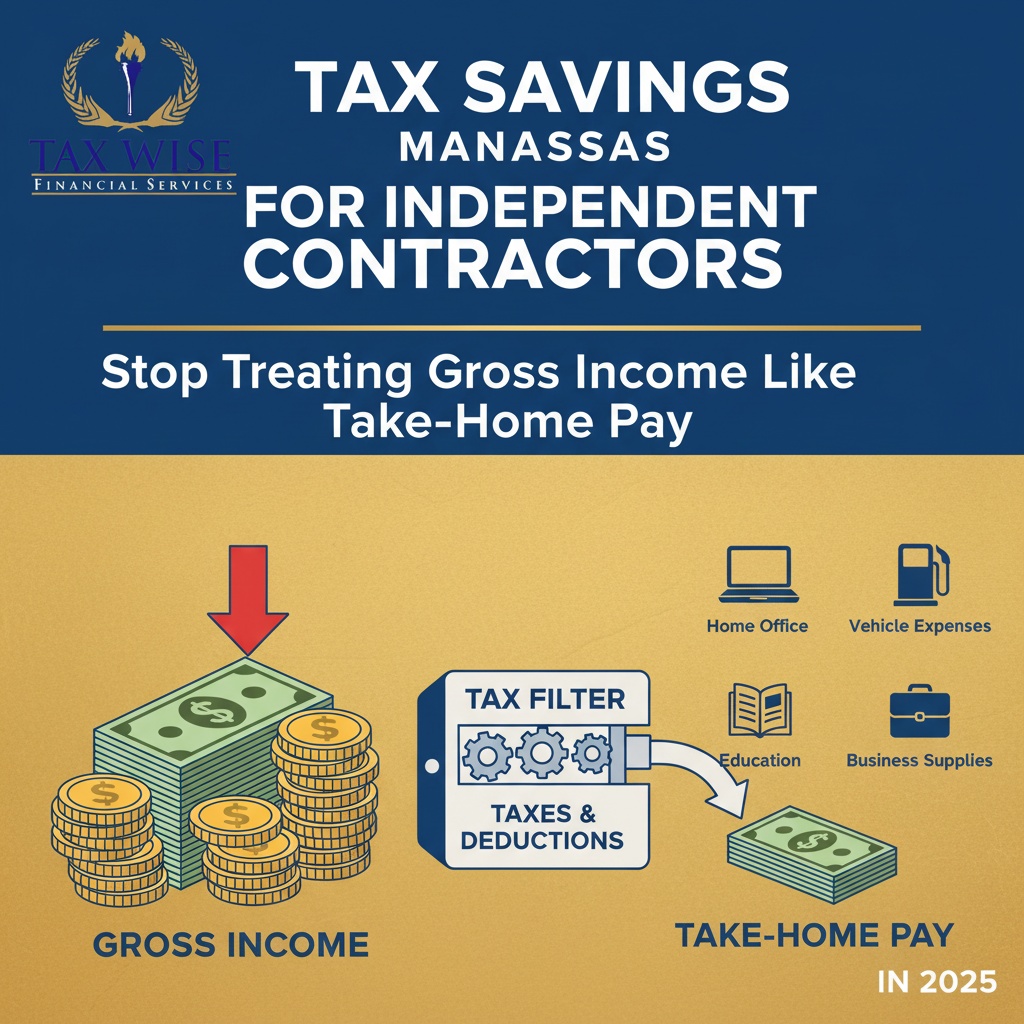
For independent contractors, Tax Savings Manassas starts with understanding one important financial rule: the money clients pay you is not the same as the money you can safely take home. Unlike a traditional employee who receives a paycheck after taxes have been withheld, an independent contractor generally receives gross payments and must personally plan for taxes, business expenses, savings, and other obligations.
This distinction may sound simple, but overlooking it can create serious cash-flow problems. A contractor can have a profitable year and still struggle when estimated taxes or annual tax bills become due.
The solution starts with changing how you look at every client payment.
Why Gross Income Is Not Your Take-Home Pay
Suppose your independent contracting business brings in $8,000 this month.
It can be tempting to look at your bank balance and think you have earned $8,000 that is available to spend. In reality, that money may need to cover several different obligations before you determine what is available for personal use.
Those obligations can include:
- Federal income taxes
- Self-employment taxes
- Virginia income taxes
- Business operating expenses
- Insurance
- Software and subscriptions
- Equipment purchases
- Retirement contributions
- Emergency business reserves
If you spend based on gross revenue instead of what remains after these obligations, you may eventually find yourself short on cash.
Independent contractors therefore need to distinguish between revenue, business profit, tax reserves, and personal income.
Tax Savings Manassas Starts With Knowing Your Real Income
One of the foundations of Tax Savings Manassas planning is knowing what your business actually earns after legitimate business expenses.
Consider a simplified example.
Your business receives $100,000 in client payments during the year. During that same period, you have $20,000 in qualifying business expenses.
That means:
Gross business revenue: $100,000
Business expenses: $20,000
Remaining business profit before other applicable adjustments: $80,000
The $100,000 deposited by clients should not automatically be treated as a $100,000 personal salary.
This distinction matters because taxes for a self-employed individual are generally tied to net earnings rather than simply the amount of cash deposited into a business account.
Accurate bookkeeping makes it much easier to see this difference throughout the year.
Best Business Accountant Manassas for Retirement Plan Strategies in 2025.
Understand Self-Employment Taxes
Traditional employees generally split Social Security and Medicare taxes with their employers.
Independent contractors operate differently.
Self-employed individuals generally have responsibility for self-employment tax, which covers Social Security and Medicare taxes. The standard self-employment tax rate is generally 15.3%, although the actual calculation involves additional rules and does not mean every dollar of gross revenue is simply taxed at 15.3%.
Self-employment tax is also separate from federal income tax.
That is an important distinction.
A contractor who receives $5,000 from a client should not assume that setting aside money for federal income tax alone covers every federal tax obligation.
Your specific liability depends on factors such as net earnings, filing status, deductions, credits, other household income, and the tax rules applicable to that year.
Create a Separate Tax Reserve
One of the simplest ways independent contractors can improve financial organization is by maintaining money specifically for taxes.
Instead of leaving every dollar in one checking account, consider separating tax money from operating and personal funds.
For example, your financial system could include:
- A business operating account
- A tax savings account
- An emergency or business reserve
- A personal account
When clients pay invoices, a portion of the money can be transferred into the tax account before the remaining cash is considered available.
There is no single percentage that is appropriate for every independent contractor. Your required amount depends on your individual tax situation.
The important habit is to reserve the money before spending it.
This creates a financial boundary between business revenue and personal spending.
Tax Savings Manassas and Quarterly Estimated Payments
Another important part of Tax Savings Manassas planning is understanding estimated taxes.
Independent contractors may need to make estimated tax payments during the year rather than waiting until they file their annual return.
Federal estimated tax payments can cover obligations such as income tax and self-employment tax.
Waiting until tax season to think about these obligations can create two problems.
First, you may face a large payment all at once.
Second, depending on your circumstances, failing to make sufficient estimated payments during the year can potentially result in an underpayment penalty.
A better approach is to review your estimated tax position periodically.
If your business grows substantially during the year, the amount you previously planned to pay may no longer reflect your current income.
Best Business Accountant Manassas for Quarterly Tax Planning in 2025
Don’t Forget About Virginia Taxes
Manassas independent contractors should remember that federal taxes are only one part of their tax planning.
Virginia has its own individual income tax and estimated-payment requirements.
That means sending estimated payments to the federal government does not automatically take care of your Virginia obligations.
Consider tracking federal and Virginia tax reserves separately in your bookkeeping system. This can help you understand what has already been paid and what may still be due.
If your income changes substantially, review both federal and state estimates rather than assuming last year’s numbers remain appropriate.
Track Legitimate Business Expenses
Tax planning should not only focus on how much money you need to reserve.
It should also include identifying and properly documenting legitimate business expenses.
Depending on your occupation and circumstances, potentially deductible business expenses could include qualifying costs associated with:
- Advertising and marketing
- Business insurance
- Accounting and professional services
- Software subscriptions
- Office supplies
- Business equipment
- Professional memberships
- Education related to your existing business
- Business travel
- Vehicle expenses for qualifying business use
- Certain home-office expenses
The tax treatment of individual expenses varies. Simply paying for something from a business bank account does not automatically make it deductible.
Good records are therefore essential.
Keep receipts, invoices, mileage records where applicable, bank statements, and other documentation supporting business transactions.
Can I Pay My Kids Under My LLC? How to Do It Legally In 2025
Don’t Wait Until Tax Season to Organize Your Books
Bookkeeping should be an ongoing process rather than an annual project.
Imagine trying to remember why you spent $275 at a particular store 11 months ago. Without a receipt or properly categorized transaction, determining whether that purchase was personal or business-related can become difficult.
A monthly bookkeeping routine is much easier.
Your Monthly Financial Checklist
At least once each month, consider reviewing:
- Total business revenue
- Business expenses
- Accounts receivable
- Bank and credit card transactions
- Estimated business profit
- Tax reserves
- Upcoming estimated payments
- Cash available for personal use
This process gives you a clearer picture of the financial health of your business.
It can also help you identify problems before they become expensive surprises.
Give Yourself a Realistic Owner’s Pay
Independent contractors often transfer money to themselves whenever there is cash in the business account.
That can make personal budgeting difficult.
Instead, consider developing a consistent system for determining how much money you can safely use personally.
Think of incoming revenue as moving through several stages:
Revenue → Business Expenses → Tax Reserves → Business Reserves → Available Owner Funds
The exact system will depend on your business and tax structure, but the underlying principle remains the same.
Do not decide what you can spend personally based only on the amount clients have paid you.
Tax Savings Manassas Goes Beyond Finding Write-Offs
Many business owners associate tax planning with finding deductions.
Deductions matter, but effective Tax Savings Manassas planning can involve much more.
Depending on your circumstances, tax planning may include evaluating:
- Business structure
- Retirement contributions
- Health insurance deductions
- Timing of qualifying business expenses
- Equipment purchases
- Estimated tax payments
- Recordkeeping procedures
- Cash-flow planning
The goal should not be to spend money simply to create a deduction.
Spending $1 solely to save a fraction of that amount in taxes usually does not make economic sense.
Instead, focus on expenses and strategies that support the business while receiving the tax treatment legally available to you.
Best Business Accountant Manassas for Small Business Owners in 2025
Should Independent Contractors Consider an LLC or S Corporation?
As an independent contractor’s income increases, questions about LLCs and S corporations often follow.
It is important to understand that these terms describe different concepts.
An LLC is a legal business structure established under state law. An S corporation is a federal tax classification available to qualifying businesses that make the appropriate election.
An LLC may potentially elect S corporation taxation if it qualifies, but that does not mean an S corporation is automatically the right choice for every profitable independent contractor.
S corporation taxation can involve additional requirements, including payroll, tax filings, bookkeeping, and compliance responsibilities.
The potential tax impact should therefore be compared with the additional administrative costs before making a decision.
Avoid Lifestyle Inflation When Business Is Growing
A strong month can create a false sense of financial security.
Suppose your normal monthly revenue is $6,000, but you suddenly have several successful months producing $10,000 or $12,000.
It can be tempting to immediately increase personal spending.
But higher revenue may also mean higher estimated tax obligations.
Before increasing your lifestyle expenses, determine what the additional revenue means for:
- Federal taxes
- Virginia taxes
- Business expenses
- Cash reserves
- Retirement planning
- Future business investments
Your business may be growing, but that does not mean every additional dollar is available for personal consumption.
Build an Emergency Fund for Your Business
Independent contractor income can fluctuate.
One month may be extremely profitable, while another may be slower because a major client delays a project or invoice.
Maintaining a business reserve can help smooth those fluctuations.
Instead of withdrawing every dollar left after paying immediate expenses, consider keeping enough cash available to handle periods of lower revenue or unexpected costs.
A reserve may help cover expenses such as insurance, subscriptions, equipment replacement, professional fees, and other obligations even during a slow month.
This is another reason gross income should never be confused with take-home pay.
Review Your Tax Strategy as Your Income Changes
A tax approach that worked when your business generated $40,000 annually may not necessarily remain appropriate when revenue reaches $100,000 or $200,000.
As your business changes, review your financial strategy.
Questions worth considering include:
- Are estimated tax payments still sufficient?
- Are you capturing all legitimate business expenses?
- Has your business structure become inefficient?
- Are you maintaining adequate cash reserves?
- Are retirement contributions part of your financial plan?
- Is bookkeeping accurate and current?
- Are you taking too much cash out of the business?
Periodic reviews can prevent small financial mistakes from becoming larger problems.
Better Tax Savings Manassas Begins With Better Cash Management
The biggest lesson for independent contractors is simple:
Gross revenue is not take-home pay.
Every client payment needs to support more than your personal expenses. Your business may also need to cover operating costs, federal taxes, Virginia taxes, future expenses, and financial reserves.
A disciplined system can make this much easier.
Separate business and personal finances. Track expenses consistently. Maintain a tax reserve. Review estimated payments. Monitor profitability instead of focusing only on revenue.
Most importantly, decide what you can afford to take home after considering your business and tax obligations—not before.
For independent contractors looking for Tax Savings Manassas, this shift in thinking can create better cash flow, fewer tax-season surprises, and a clearer understanding of how much the business is actually producing for you.
For additional information about federal obligations for independent contractors, consult the IRS Self-Employed Individuals Tax Center.
At TaxWise Corp, we help small business owners across the USA navigate the complex tax landscape, optimize deductions, and protect their financial future. Don’t leave money on the table, start planning today!
Contact TaxWise Corp to schedule your 2025 Tax Planning Consultation and ensure your business saves every possible dollar.