
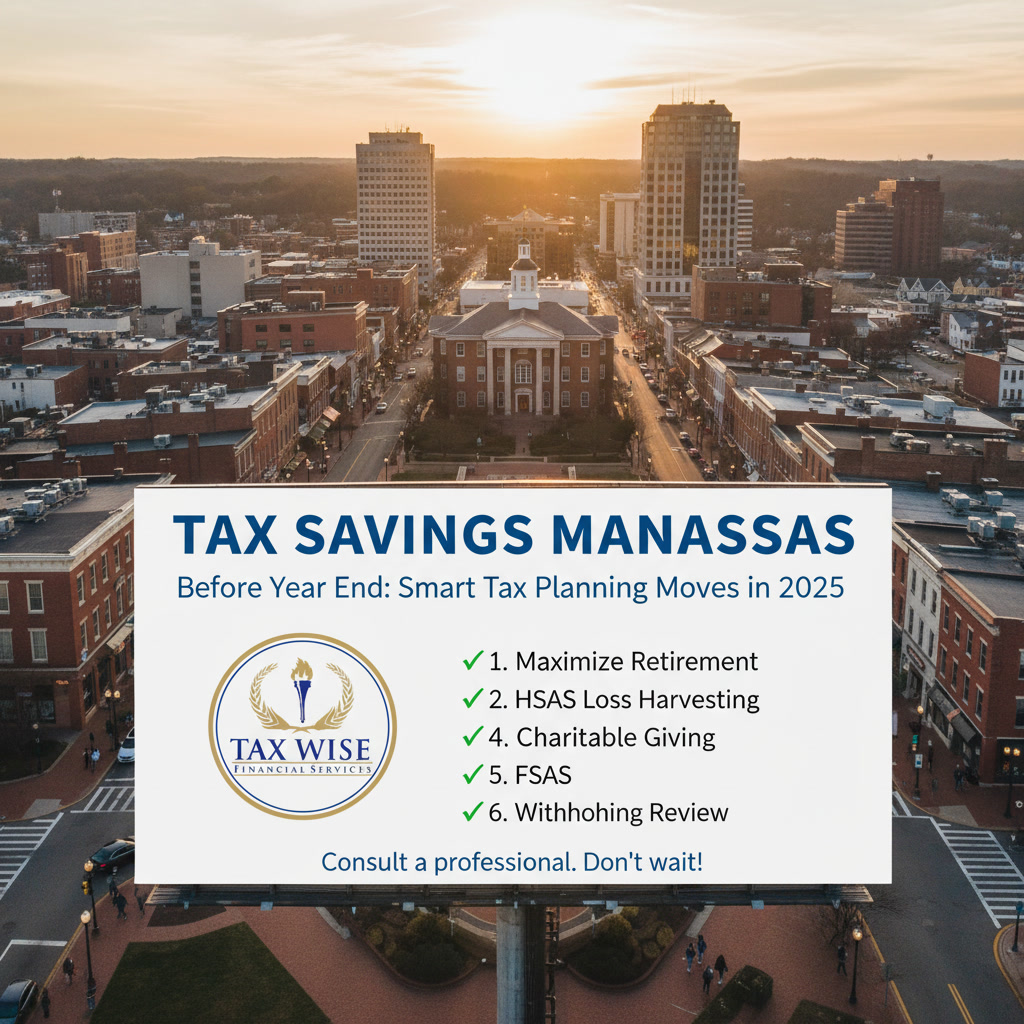
As December approaches, taxes may not be the first thing on your holiday checklist. But for individuals, families, and business owners in Manassas, Virginia, the final weeks of the year can be one of the most important tax-planning periods.
Many valuable tax strategies are tied to the calendar year. Once December 31 passes, you may lose the opportunity to take certain actions that could affect that year’s tax bill.
If you’re looking for Tax savings Manassas strategies before year-end, the key is to review your financial picture early enough to act. Retirement contributions, charitable giving, business expenses, investment decisions, Virginia-specific deductions, and tax payments may all deserve attention.
Below are several tax planning moves to consider before the calendar flips to a new year.
Why Year-End Tax Planning Matters
Tax preparation and tax planning aren’t the same thing.
Tax preparation generally focuses on accurately reporting transactions that have already happened. Tax planning looks ahead and asks whether there are legitimate steps you can take to improve your tax position before important deadlines arrive.
That’s particularly important near year-end because some transactions must occur during the tax year to have the desired tax effect.
For example, the IRS states that charitable contributions generally must actually be paid before the close of the tax year to qualify for that year’s charitable contribution deduction.
Waiting until tax-filing season to think about these opportunities can therefore be too late.
1. Review Your Income Before December 31
Start by estimating your total income for the year.
Depending on your situation, that may include:
- Wages and salaries
- Self-employment or business income
- Bonuses and commissions
- Investment income
- Rental income
- Capital gains
- Retirement distributions
- Other taxable income
Knowing approximately where your income will land can help you and your tax professional identify potential planning opportunities.
The IRS notes that adjusted gross income, or AGI, is an important factor in determining taxes and that some tax-planning strategies can reduce AGI.
Consider the Timing of Income and Expenses
Business owners and self-employed taxpayers may have more control over when certain income is received or expenses are paid.
Depending on your accounting method and individual circumstances, it may make sense to evaluate whether legitimate business expenses should be completed before year-end or whether the timing of income can be managed appropriately.
This isn’t simply about pushing income into another year. Accelerating or delaying income can affect deductions, credits, estimated taxes, cash flow, and future tax brackets.
That’s why income timing should be evaluated as part of a broader tax strategy rather than as a standalone tactic.
2. Review Your Retirement Contributions
Retirement planning can provide both long-term financial benefits and potential tax advantages.
Certain contributions to workplace retirement plans and traditional IRAs may reduce taxable income, depending on the type of plan and the taxpayer’s circumstances.
Before year-end, review:
- How much you’ve contributed to an employer-sponsored retirement plan
- Whether you’re eligible to increase contributions
- Whether an IRA contribution could provide additional benefits
- Whether you’re potentially eligible for the Saver’s Credit
For 2025, the IRS states that eligible taxpayers may qualify for the Retirement Savings Contributions Credit based on filing status, income, and qualifying retirement contributions.
Not every retirement contribution has a December 31 deadline, however. IRA contribution deadlines, for example, can differ from workplace-plan deadlines. Verify the deadline applicable to the particular account you’re considering.
3. Make Planned Charitable Contributions on Time
If charitable giving is already part of your financial plan, year-end can be a good time to review your contributions.
For 2025 federal returns, taxpayers generally need to itemize deductions on Schedule A to deduct qualifying charitable contributions. Donations also need to go to qualified organizations and are subject to applicable limitations and documentation requirements.
If you plan to make deductible contributions for the year, don’t leave them until after December 31.
Keep Proper Donation Records
Documentation is essential.
Depending on the donation, you may need receipts, acknowledgment letters, bank records, appraisals, or other documentation. Noncash donations can involve additional requirements.
Also remember that donations to individuals aren’t deductible charitable contributions. The IRS provides a Tax Exempt Organization Search tool that taxpayers can use to check whether an organization is eligible to receive tax-deductible contributions.
For larger donations or gifts of appreciated assets, consult a qualified tax professional before completing the transaction.
4. Review Investment Gains and Losses
Investors should review taxable investment accounts before year-end.
If you’ve sold investments at a gain during the year, selling other investments at a loss may potentially offset some capital gains. This approach is commonly known as tax-loss harvesting.
However, investment decisions shouldn’t be made solely for tax purposes.
Before selling an investment, consider:
- Your long-term investment strategy
- Realized gains and losses for the year
- Short-term versus long-term capital gains
- Transaction costs
- The wash-sale rules
- Whether selling still makes financial sense
A tax professional and financial advisor can help you understand how investment and tax considerations interact.
5. Don’t Overlook Virginia-Specific Tax Opportunities
Federal taxes are only part of the picture for Manassas residents. Virginia’s individual income tax rules can create additional planning considerations.
One important example is Virginia’s deduction for eligible contributions to certain Commonwealth Savers accounts, formerly associated with Virginia529.
Virginia Tax states that taxpayers under age 70 generally may deduct the lesser of $4,000 or the amount contributed during the taxable year to each qualifying account, with eligible excess amounts carried forward to future years. Different treatment can apply to taxpayers age 70 or older.
That makes state-level planning an important component of Tax savings Manassas strategies.
Rather than looking only at your federal return, review your federal and Virginia tax positions together.
6. Check Your Federal Tax Withholding
Did your financial situation change during the year?
Maybe you:
- Started a new job
- Received a substantial raise or bonus
- Added freelance income
- Started a business
- Got married
- Had a child
- Generated significant investment income
Changes like these can affect how much tax you ultimately owe.
The federal income tax system generally operates on a pay-as-you-go basis. The IRS recommends checking withholding during the year, particularly when personal or financial circumstances change. Employees can use the IRS Tax Withholding Estimator and submit an updated Form W-4 when an adjustment is appropriate.
A year-end withholding review can help identify potential underpayment before filing season arrives.
7. Review Estimated Tax Payments
Business owners, freelancers, independent contractors, investors, and others without sufficient paycheck withholding may need to make estimated tax payments.
Individuals, including sole proprietors, partners, and S corporation shareholders, generally use Form 1040-ES to calculate federal estimated taxes.
The IRS warns that taxpayers who don’t pay enough tax during the applicable payment periods may face an underpayment penalty—even if they’re ultimately entitled to a refund when they file.
Review your estimated payments against your actual year-to-date income instead of automatically assuming the amount you calculated at the beginning of the year remains accurate.
8. Business Owners Should Review Purchases and Expenses
For Manassas business owners, year-end planning deserves special attention.
Start by reviewing major purchases, planned expenses, equipment needs, accounts receivable, payroll, retirement plans, and other transactions.
Potential areas to discuss with a tax advisor include:
- Equipment purchases
- Business vehicles
- Office technology
- Software and subscriptions
- Employee bonuses
- Retirement-plan contributions
- Business insurance
- Professional services
- Outstanding invoices
- Estimated tax obligations
Timing can matter, but purchasing something solely to obtain a tax deduction isn’t automatically a smart business decision.
Spending $1 simply to deduct $1 generally doesn’t put you ahead financially. The purchase should first make sense for the business.
9. Organize Your Tax Records Before Filing Season
One of the easiest year-end tax moves doesn’t involve spending money at all.
Get organized.
Gather documents for major purchases, charitable contributions, business expenses, investment transactions, estimated tax payments, and other tax-related activity.
For business owners, make sure bookkeeping records are reconciled and that personal and business expenses are properly separated.
Better records can help your tax professional identify deductions or credits you might otherwise overlook while also reducing the stress of tax season.
10. Schedule a Year-End Tax Planning Review
The most useful tax strategies depend on your specific circumstances.
A strategy that’s valuable for one Manassas taxpayer could be irrelevant—or even counterproductive—for another.
For example, your ideal approach may depend on:
- Filing status
- Household income
- Business ownership
- Retirement accounts
- Investment activity
- Charitable giving
- Dependents
- Itemized versus standard deductions
- Virginia-specific deductions
- Expected changes in next year’s income
A year-end tax planning appointment gives you an opportunity to review these factors while there may still be time to act.
What Can Disappear After December 31?
Not every tax deadline falls on December 31, but many planning opportunities depend on completing a transaction within the applicable tax year.
That distinction is important.
A contribution, payment, purchase, sale, or other financial decision completed in January generally belongs to the new calendar year unless a specific tax rule provides otherwise.
Some of the areas that may require action before year-end include:
- Certain workplace retirement contributions
- Qualifying charitable gifts intended for the current tax year
- Investment sales used as part of a gain/loss strategy
- Certain business purchases or expenses
- State-specific contributions or deductions tied to the taxable year
Other opportunities, including some IRA contributions, may remain available after December 31. Always confirm the applicable deadline rather than assuming every tax-saving strategy expires at year-end.
Build a Tax Strategy Before the Deadline
Effective tax planning isn’t about chasing every possible deduction. It’s about understanding which strategies fit your financial circumstances and completing time-sensitive actions before their deadlines.
For residents and business owners exploring Tax savings Manassas opportunities, November and December can be especially valuable months for reviewing income, retirement savings, charitable giving, investments, business expenses, withholding, estimated payments, and Virginia-specific tax provisions.
Once December 31 passes, some opportunities for the current tax year may be gone.
Planning early gives you more choices—and more time to make informed decisions instead of scrambling during tax season.
Talk With a Manassas Tax Professional Before Year-End
Tax laws and individual circumstances can be complicated, and seemingly small financial decisions can have unexpected consequences.
If you’re considering year-end tax moves, speak with a qualified tax professional who can review your federal and Virginia tax situation and determine which strategies apply to you.
The goal isn’t simply to find deductions. It’s to build a tax plan that supports your broader financial goals while keeping you compliant with applicable tax rules.
Internal links:
Year-End Tax Planning with a CPA Near Me in Manassas VA in 2025
Real Estate Accountant Manassas: Mid-Year Tax Planning in 2025
Tax Prep Manassas: Common Mistakes We See Every Year in 2025
External resource: IRS Year-Round Tax Planning Tips
At TaxWise Corp, we help small business owners across the USA navigate the complex tax landscape, optimize deductions, and protect their financial future. Don’t leave money on the table, start planning today!
Contact TaxWise Corp to schedule your 2025 Tax Planning Consultation and ensure your business saves every possible dollar.