
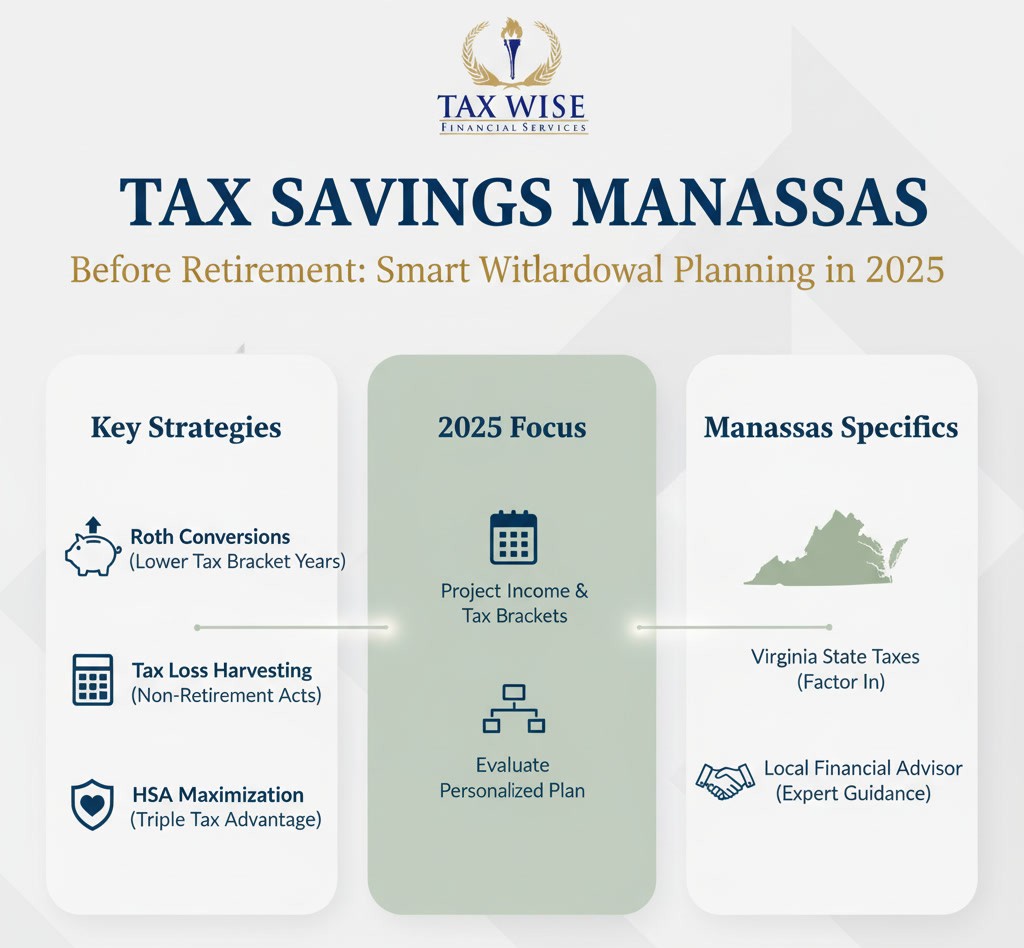
Retirement planning is about more than deciding when to stop working. For residents of Manassas, Virginia, one of the most important parts of preparing for retirement is deciding where your income will come from and in what order you will access it.
A retirement portfolio may include a 401(k), traditional IRA, Roth IRA, pension, Social Security benefits, taxable investment accounts, savings, or other income sources. Each can have different federal and Virginia tax consequences. That means the decisions you make in the final years of your career may affect how much of your retirement savings you actually get to spend.
Thoughtful planning for Tax savings Manassas Before Retirement can help you evaluate withdrawals before leaving the workforce, manage taxable income, and create a retirement-income strategy that fits your long-term goals.
Why Tax Planning Before Retirement Matters
Many people focus heavily on accumulating retirement savings but spend less time planning how they will eventually withdraw that money. Yet retirement withdrawals can create significant tax consequences.
Traditional retirement-plan distributions generally must be included in taxable income unless an exclusion applies, while qualified Roth distributions can generally be tax-free.
The timing of withdrawals can therefore matter almost as much as the amount withdrawn.
For example, someone retiring with substantial savings in a traditional 401(k) may eventually have taxable distributions from that account in addition to Social Security, pension income, investments, and other sources. Without advance planning, those income streams could overlap in ways that increase taxable income.
Planning before your final paycheck gives you an opportunity to examine these interactions rather than reacting to them after retirement.
Planning Withdrawals and Income Sources Before Leaving the Workforce
A retirement-income plan should answer a deceptively simple question:
Where will your next dollar of retirement income come from?
The answer may change from year to year.
Someone retiring at 62 could have several years before required minimum distributions become relevant. Another person may retire later and transition almost immediately into required withdrawals. Someone else may continue consulting or working part time.
A useful starting point is to inventory potential retirement-income sources, including:
- Employer-sponsored 401(k), 403(b), or similar retirement accounts
- Traditional IRAs
- Roth IRAs and Roth workplace accounts
- Social Security benefits
- Pension or annuity payments
- Taxable brokerage accounts
- Bank savings and certificates of deposit
- Rental or business income
- Part-time or consulting income
Once you know what income sources will be available, you can begin estimating their tax characteristics and determining an appropriate withdrawal sequence.
Understand the Tax Treatment of Your Retirement Accounts
Different accounts should not automatically be treated as interchangeable.
Traditional 401(k)s and IRAs
Distributions from traditional tax-deferred retirement accounts are generally included in taxable income except to the extent a distribution represents amounts already taxed or another exclusion applies.
That can make the size and timing of withdrawals important.
Suppose you need $80,000 for living expenses during your first year of retirement. Taking the entire amount from a traditional IRA could produce a very different tax result than combining traditional IRA withdrawals with cash savings, taxable investments, or qualified Roth distributions.
The goal isn’t simply to minimize taxes this year. It is to consider taxes over the course of retirement.
Roth Accounts
Qualified Roth distributions generally receive tax-free federal treatment. This can make Roth assets particularly useful when you need additional spending money without necessarily increasing taxable retirement income.
That does not mean retirees should always spend Roth accounts first or save them until last. The appropriate strategy depends on your income, age, account balances, estate objectives, and other circumstances.
For Tax savings Manassas Before Retirement, having multiple types of accounts may provide greater flexibility when building a withdrawal plan.
Look for Lower-Income Tax Windows
The period immediately after retirement can sometimes create a valuable planning opportunity.
Imagine that you retire at 63. Your salary disappears, but you haven’t yet started every potential source of retirement income. Depending on your circumstances, your taxable income could temporarily fall.
That period may offer opportunities to deliberately recognize income at potentially more favorable rates.
One strategy worth evaluating is a Roth conversion. Instead of waiting until future withdrawals are required, you may choose to convert part of a traditional IRA to a Roth IRA and recognize the taxable income during a strategically selected year.
A conversion is not automatically beneficial. Converting too much at once can increase taxable income and potentially affect other tax-sensitive calculations. The appropriate amount should be modeled carefully.
Don’t Ignore Required Minimum Distributions
Required minimum distributions, or RMDs, can significantly affect long-term retirement tax planning.
Under current federal rules, traditional IRAs and many retirement plans generally become subject to RMD requirements beginning at age 73, although workplace-plan rules and individual circumstances can affect timing. Roth IRAs and designated Roth accounts generally do not require lifetime distributions from the original owner.
This creates an important planning question:
How large could your tax-deferred accounts become before RMDs begin?
If you enter retirement with substantial traditional retirement assets and allow those accounts to continue growing without withdrawals, future required distributions could add significantly to taxable income.
Taking carefully planned withdrawals or considering partial Roth conversions during lower-income years may help manage that future exposure.
This is one reason Tax savings Manassas Before Retirement should be viewed as a multi-year strategy rather than a single-year tax exercise.
Consider Virginia Taxes Alongside Federal Taxes
Manassas retirees also need to consider Virginia income-tax rules.
Virginia’s treatment of retirement-related income does not always mirror federal taxation. For example, Virginia permits a subtraction for taxable Social Security and equivalent Tier 1 Railroad Retirement benefits included in federal adjusted gross income. Virginia also provides an age deduction for qualifying taxpayers, although eligibility and the available amount depend on factors including birth date, income, and filing status.
For 2025, qualifying taxpayers age 65 and older may be eligible for an age deduction of up to $12,000 each, subject to Virginia’s applicable eligibility and income rules.
These rules make coordinated federal-and-state planning important. A strategy that appears attractive when looking only at federal income taxes may produce a different result once Virginia taxes are included.
Coordinate Social Security With Your Withdrawal Strategy
The question of when to claim Social Security should not be considered separately from retirement withdrawals.
If you delay claiming benefits, you may need to fund living expenses from other sources in the meantime. Those withdrawals have tax consequences of their own.
For example, a retiree might use a combination of cash reserves and retirement-account withdrawals during the years before Social Security begins. Another might continue working part time. A third might intentionally use those years for partial Roth conversions.
Rather than asking only, “When should I claim Social Security?” consider asking:
How should Social Security fit into my overall retirement-income and tax strategy?
That broader question can produce a more useful plan.
Be Careful With Large Lump-Sum Withdrawals
A common retirement mistake is treating a retirement account like an ordinary savings account.
A large taxable withdrawal can substantially increase income in a single year. In addition, eligible employer-plan distributions paid directly to you rather than transferred through a qualifying direct rollover are generally subject to 20% federal income-tax withholding.
Withholding also should not be confused with your final tax liability. The amount withheld may be more or less than what you ultimately owe.
Whenever you are considering a large withdrawal, estimate the tax impact before requesting the distribution.
Review Early-Withdrawal Rules Before Retiring Early
Anyone planning to leave the workforce before age 59½ needs additional care.
The IRS generally imposes an additional 10% tax on taxable early distributions from IRAs and retirement plans unless an exception applies. Different exceptions can apply depending on the account and circumstances.
That makes account sequencing especially important for early retirees.
Someone leaving work in their 50s, for example, should understand the rules applying to their employer plan and IRAs before automatically rolling accounts over or beginning withdrawals.
Professional guidance can be valuable here because an otherwise reasonable transaction may change which withdrawal rules apply.
Build a Multi-Year Retirement Tax Projection
One of the strongest ways to pursue Tax savings Manassas Before Retirement is to stop looking at retirement taxes one calendar year at a time.
Create projections covering several stages of retirement.
Final Working Years
Estimate salary, bonuses, retirement contributions, investment income, and other taxable income. These may be among your higher-income years, so large voluntary taxable distributions or conversions may not always be attractive.
Early Retirement
Model the period after your paycheck ends but before all retirement-income sources begin. These years may provide additional flexibility for withdrawals or Roth conversions.
Social Security and Pension Years
Add expected Social Security and pension income to the projection and determine how much additional portfolio income you will need.
RMD Years
Estimate future required distributions from tax-deferred retirement accounts. Current IRS rules generally require RMDs beginning at age 73 for affected accounts, although applicable rules should always be confirmed for your circumstances.
Seeing these phases together can reveal opportunities that are difficult to identify when looking only at the current year’s tax return.
Questions to Ask Before Your Last Day at Work
Before retiring, consider discussing these questions with your financial and tax professionals:
- How much annual income will I actually need after taxes?
- Which accounts should fund my first few years of retirement?
- Should I make traditional or Roth contributions during my final working years?
- Would partial Roth conversions make sense after retirement?
- When should I begin Social Security?
- How could future RMDs affect my taxable income?
- How will Virginia taxation affect my withdrawal strategy?
- Should I keep funds available outside retirement accounts for near-term expenses?
- Are there years when intentionally recognizing additional taxable income could make sense?
- How much federal and Virginia tax should I withhold from retirement distributions?
The important point is that these decisions interact. Changing your Social Security date, for example, may change how much you need to withdraw from an IRA, which could change taxable income and affect other planning decisions.
Create a Withdrawal Strategy Before You Retire
Retirement planning shouldn’t end when you’ve accumulated enough money to leave work. That is when distribution planning becomes increasingly important.
For Manassas residents approaching retirement, a well-designed withdrawal strategy can coordinate traditional retirement accounts, Roth assets, Social Security, pensions, investments, and cash reserves while considering both federal and Virginia taxes.
Effective Tax savings Manassas Before Retirement starts before your final paycheck. By modeling multiple years, understanding how different income sources are taxed, anticipating RMDs, and coordinating withdrawals with Social Security and other retirement income, you can make more informed decisions about how your savings support your retirement.
Tax laws and individual circumstances change, so retirement-income strategies should be reviewed regularly with qualified tax and financial professionals.
Internal Links
Smart Retirement Planning: Investing Through a Self-Directed IRA – Rules and Red Flags in 2025
Best Business Accountant Manassas for Quarterly Tax Planning in 2025.
Tax Planning Tips from a Manassas CPA in 2025
External Resource
For authoritative federal guidance, readers can consult the IRS Required Minimum Distributions guide. The IRS explains RMD timing, taxation, and related retirement-account requirements.
At TaxWise Corp, we help small business owners across the USA navigate the complex tax landscape, optimize deductions, and protect their financial future. Don’t leave money on the table, start planning today!
Contact TaxWise Corp to schedule your 2025 Tax Planning Consultation and ensure your business saves every possible dollar.