
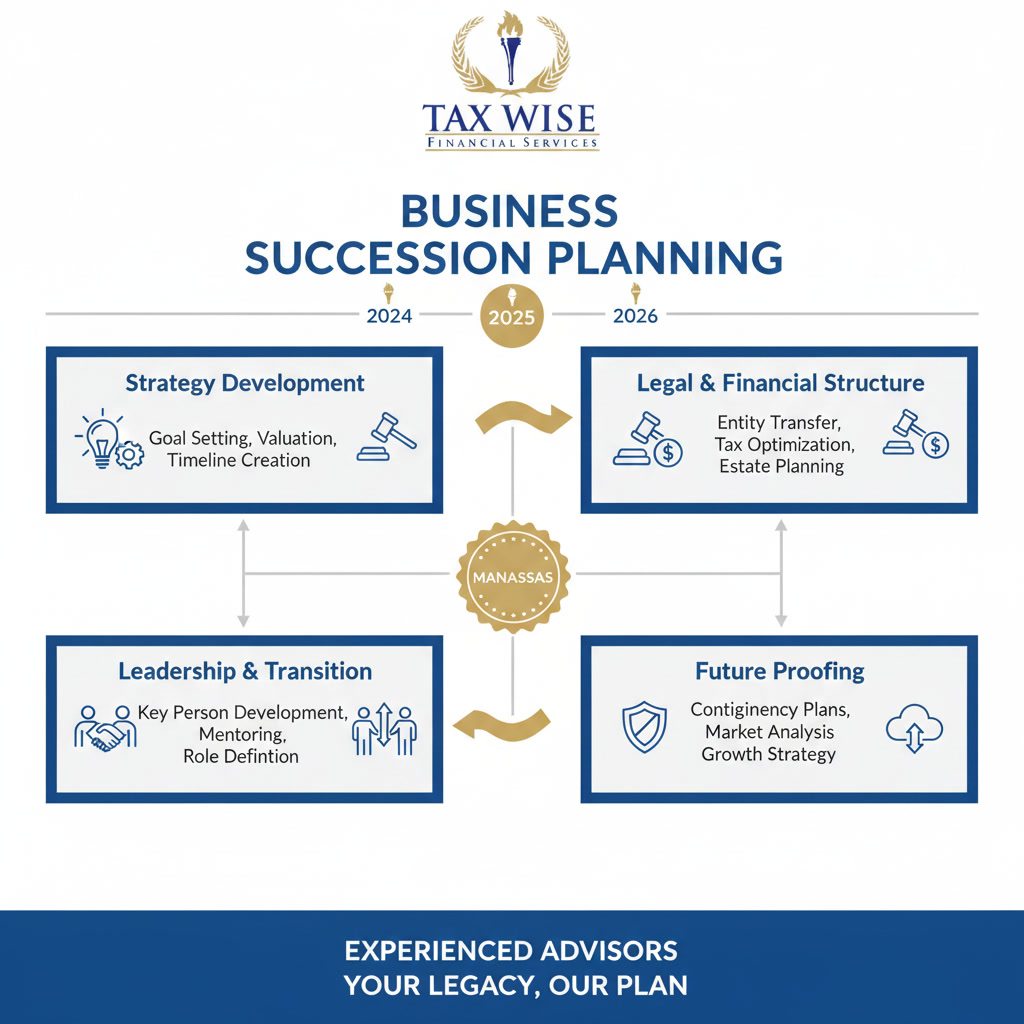
Preparing Your Company for a Smooth Ownership Transition
Building a successful business takes years of hard work, careful financial management, and strategic decision-making. But what happens when it is time to retire, transfer ownership to a family member, bring in a new partner, or sell the company?
A well-designed business succession plan can help protect the value you have created while preparing the company, its employees, and its future owners for the transition. For business owners in Manassas, Virginia, working with the best business accountant Manassas can be an important part of that process.
Succession planning involves much more than deciding who will run the company next. Financial statements need to be accurate, the business may need to be valued, potential tax consequences should be evaluated, and the transition needs to make financial sense for both the current and future owners.
The U.S. Small Business Administration (SBA) recommends careful planning when transferring business ownership and notes that owners may benefit from professional guidance from accountants, attorneys, valuation specialists, and other advisors.
Here is how an experienced business accountant can help prepare your Manassas company for a smoother ownership transition.
What Is Business Succession Planning?
Business succession planning is the process of preparing for the future transfer of a company’s ownership, management, or both.
The transition could happen because an owner plans to retire, wants to pursue another opportunity, experiences an unexpected life event, or simply decides that it is the right time to sell.
Common succession strategies include:
- Transferring the company to children or other family members
- Selling ownership to an existing partner
- Selling the business to employees or management
- Bringing in new investors or owners
- Selling to an outside individual or company
- Gradually transferring ownership over several years
Each approach creates different financial, tax, operational, and legal considerations. That is why succession planning is generally more effective when it begins well before the intended transition date.
Why Your Accountant Matters in Succession Planning
Business succession is fundamentally a financial event.
Even when ownership remains within the family, questions quickly arise about the company’s value, taxes, cash flow, debt, compensation, and the outgoing owner’s financial needs.
Working with the best business accountant Manassas for your company’s circumstances can give you a clearer picture of where the business stands today and what needs to happen before ownership changes.
1. Getting Your Financial Records Ready
Potential buyers, lenders, investors, and successors need reliable financial information.
Your accountant can help organize and review records such as:
- Income statements
- Balance sheets
- Cash flow statements
- Business tax returns
- Accounts receivable and payable
- Payroll records
- Fixed-asset schedules
- Outstanding business debt
- Owner compensation and distributions
Clean financial records can make due diligence easier and help potential successors understand the company’s true financial performance.
The SBA recommends that established businesses maintain historical financial statements and develop financial projections when planning for future financing and strategic decisions.
Establishing a Realistic Business Value
One of the biggest questions during succession planning is simple:
What is the business actually worth?
Owners sometimes estimate value based on years of effort, revenue, assets, or what they believe a buyer should pay. However, a credible valuation typically requires a more structured analysis.
The SBA identifies three common approaches to business valuation:
- Income approach: Evaluates projected earnings while considering risk.
- Market approach: Compares the company with similar businesses that have been sold.
- Asset approach: Examines the value of assets after accounting for liabilities.
An accountant can help organize the financial information required by a qualified valuation professional and identify unusual or one-time expenses that may need consideration when analyzing normalized earnings.
Why Valuation Matters Before the Transition
Knowing the approximate value of your business can help you:
- Establish realistic expectations for a sale
- Evaluate offers from potential buyers
- Structure transfers among family members
- Plan retirement income
- Consider financing requirements
- Prepare for potential tax consequences
- Address fairness among family members or partners
Waiting until a buyer appears to think about valuation can put the owner at a disadvantage. Establishing a financial baseline earlier gives you more time to improve areas that could affect business value.
Understanding the Tax Impact of an Ownership Transfer
Taxes can significantly influence how a succession strategy is structured.
For example, selling company assets can produce different tax consequences than selling an ownership interest. A gradual transfer may have different implications than an immediate sale, while transferring business interests to family members can introduce gift and estate planning considerations.
The IRS notes that business interests may form part of a person’s gross estate for federal estate-tax purposes, and applicable rules and thresholds can change over time.
Your accountant can work alongside your attorney, financial advisor, and other specialists to evaluate potential scenarios before decisions become irreversible.
Important questions can include:
How will the sale be structured?
An asset sale and an equity sale can produce substantially different financial outcomes for buyers and sellers.
Will ownership be transferred gradually?
A multi-year transfer may affect cash flow, ownership percentages, tax reporting, and financing.
Is the company staying in the family?
Family transfers can introduce additional estate, gift, valuation, and governance considerations.
How will the retiring owner be compensated?
The outgoing owner may receive a lump-sum payment, installment payments, ongoing compensation, or another arrangement depending on the transaction.
These questions illustrate why tax planning should begin before the ownership transfer is finalized—not afterward.
Improving the Business Before Succession
Succession planning is not only about transferring a business. It is also an opportunity to strengthen it.
An experienced accountant may identify financial weaknesses that could make a company less attractive to successors, buyers, or lenders.
For example, preparation may involve:
- Improving cash flow management
- Reducing unnecessary expenses
- Addressing excessive debt
- Separating personal and business expenses
- Improving accounting procedures
- Resolving outstanding tax or reporting issues
- Developing realistic financial forecasts
- Documenting recurring revenue
- Reviewing owner-dependent expenses
- Strengthening internal financial controls
Starting several years before the planned transition gives owners more opportunity to address these issues.
Creating Financial Forecasts for the Next Owner
Historical performance tells potential successors where the company has been. Financial forecasting helps demonstrate where it could go.
Your accountant can help prepare projections based on reasonable assumptions regarding:
- Revenue growth
- Operating expenses
- Payroll
- Capital expenditures
- Debt payments
- Working capital
- Cash flow
- Profitability
Forecasting can be particularly useful when a successor needs financing to purchase the company.
A buyer who understands the company’s expected cash flow can better evaluate whether the business can support acquisition debt while continuing to fund operations.
Preparing for Due Diligence
Once a serious buyer or successor becomes involved, financial due diligence is likely to become a major part of the transaction.
Instead of scrambling to find documents at the last minute, owners can prepare ahead of time.
Your accountant can help establish an organized financial package containing tax returns, financial statements, debt information, asset schedules, payroll information, and other relevant documentation.
Good preparation can reduce delays and make it easier to answer financial questions during negotiations.
Coordinating With Attorneys and Other Advisors
The best business accountant Manassas for succession planning should not operate in isolation.
A successful transition can require a team that includes:
- CPA or business accountant
- Business attorney
- Estate-planning attorney
- Financial advisor
- Business valuation professional
- Insurance professional
- Banker or lender
Accountants typically focus on financial records, tax considerations, forecasting, and transaction analysis, while attorneys handle contracts, ownership agreements, estate documents, and other legal matters.
The SBA likewise recommends obtaining qualified professional guidance when selling or transferring a business.
Questions to Ask a Business Accountant About Succession Planning
Choosing an accountant for routine bookkeeping is different from choosing one to assist with a significant ownership transition.
Before selecting an advisor, consider asking:
- Have you worked with business succession plans before?
- Do you have experience with companies in my industry?
- How will you help prepare my financial statements for a potential buyer?
- Can you coordinate with my attorney and financial advisor?
- How early should we begin tax planning?
- Can you help prepare financial forecasts?
- What financial issues should I address before selling or transferring ownership?
- How should we approach business valuation?
- What records will potential buyers or lenders want to review?
- How can we make the transition easier from an accounting perspective?
The answers can help you determine whether the accountant has the experience and collaborative approach your transition requires.
When Should Manassas Business Owners Start Succession Planning?
Ideally, succession planning begins years before the owner intends to leave.
Starting early gives you time to strengthen financial performance, organize accounting records, identify potential successors, evaluate tax strategies, and improve the company’s transferability.
Even if retirement is still years away, creating a preliminary plan can provide direction.
It can also help protect the company if an unexpected event forces an earlier-than-planned ownership change.
A Simple Business Succession Planning Checklist
As you begin preparing your company, consider these essential steps:
- Identify your preferred ownership-transition strategy.
- Establish a realistic target timeline.
- Review your financial statements and accounting records.
- Address bookkeeping or tax-reporting issues.
- Determine whether a professional business valuation is appropriate.
- Evaluate potential tax implications.
- Identify and prepare your successor.
- Develop future financial projections.
- Review company debt and cash flow.
- Organize documents for future due diligence.
- Coordinate with your accountant, attorney, and financial advisor.
- Review the succession plan regularly as circumstances change.
Succession planning is not necessarily a one-time project. Business performance, tax laws, family circumstances, and ownership goals can change, so the plan should be revisited periodically.
Choosing the Best Business Accountant Manassas for Your Transition
Finding the best business accountant Manassas business owners can rely on means looking beyond basic tax preparation.
You need someone who understands how accounting, taxation, valuation, cash flow, and long-term planning intersect during an ownership transition.
Look for an accountant who takes time to understand your objectives. Are you hoping to retire completely? Do you want to remain involved as an advisor? Are you transferring the business to your children? Do you plan to sell to employees or an outside buyer?
Those goals influence the financial strategy.
A strong accountant should help you understand your numbers clearly, identify potential problems early, and coordinate effectively with the other professionals involved in the transaction.
Prepare Today to Protect the Business You Built
A successful business succession rarely happens by accident.
Whether you plan to transfer your Manassas business to family members, sell it to employees, bring in another owner, or find an outside buyer, preparation can make the transition considerably easier.
Accurate financial records, thoughtful tax planning, realistic valuation, financial forecasting, and organized due diligence can help reduce uncertainty for everyone involved.
Working with the best business accountant Manassas for your company’s needs gives you a financial professional who can help turn a general idea about “someday leaving the business” into a structured transition strategy.
The sooner you begin, the more options you are likely to have—and the more time you have to prepare the company for its next chapter.
Internal Links
- Tax Planning Tips from a Manassas CPA in 2025
- Top Small Business Tax Deductions That Can Save You Thousands in 2025
- Best Business Accountant Manassas After a Business Acquisition in 2025
External Resource
For additional guidance on selling or transferring ownership, readers can visit the U.S. Small Business Administration’s business management and ownership-transfer guidance.
At TaxWise Corp, we help small business owners across the USA navigate the complex tax landscape, optimize deductions, and protect their financial future. Don’t leave money on the table, start planning today!
Contact TaxWise Corp to schedule your 2025 Tax Planning Consultation and ensure your business saves every possible dollar.